Test Results
| RPM |
MPH |
Knots |
GPH |
MPG |
NMPG |
SM |
NM |
dBa |
| 600 |
3.8 |
3.3 |
1.2 |
3.2 |
2.7 |
928 |
807.2 |
62 |
| 1000 |
6 |
5.2 |
2.5 |
2.4 |
2.1 |
717 |
623.6 |
64 |
| 1500 |
8.5 |
7.4 |
4.2 |
2 |
1.8 |
603 |
524.2 |
69 |
| 2000 |
9.6 |
8.3 |
6.7 |
1.4 |
1.3 |
425 |
369.2 |
73 |
| 2500 |
11.6 |
10 |
9.7 |
1.2 |
1 |
350 |
304.7 |
79 |
| 3000 |
17.1 |
14.9 |
12.6 |
1.4 |
1.2 |
399 |
347.3 |
78 |
| 3500 |
25.3 |
22 |
16.5 |
1.5 |
1.3 |
452 |
392.8 |
83 |
| 4000 |
32.3 |
28.1 |
22 |
1.5 |
1.3 |
432 |
375.7 |
85 |
| 4500 |
37.3 |
32.4 |
28.3 |
1.3 |
1.1 |
387 |
336.8 |
85 |
| 5000 |
40.4 |
35.1 |
34.5 |
1.2 |
1 |
344 |
299.3 |
85 |
| 5500 |
45.6 |
39.7 |
45.6 |
1 |
0.9 |
294 |
255.9 |
85 |
| 6000 |
49 |
42.6 |
52.6 |
0.9 |
0.8 |
274 |
238.4 |
87 |
Specifications
| Length Overall |
31'2"
9.5 m
|
| Beam |
10'9"
3.28 m
|
| Dry Weight |
8,500 lbs.
3,856 kg
|
| Tested Weight |
11,716 lbs.
5,314 kg
|
| Draft |
24"
(61 cm)
|
| Deadrise/Transom |
20-deg.
|
| Bridge Clearance |
9'5"
2.87 m
|
| Weight Capacity |
N/A
|
| Person Capacity |
N/A
|
| Fuel Capacity |
327 gal.
1,238 L
|
| Water Capacity |
30 gal.
114 L
|
| Total Weight |
11,716 lbs.
5,314 kg
|
Acceleration Times & Conditions
| Time to Plane |
3.2 sec.
|
| 0 to 30 |
7.1 sec.
|
| Ratio |
N/A
|
| Props |
17p 15 1/2 SWS2
|
| Load |
2 persons, 2/3 fuel, no water, 50 lbs. of gear
|
| Climate |
60 deg., 50 humid; wind: 10-15 mph; seas: 1
|
Engine Options
| Tested Engine |
2 x 300-hp Yamaha
|
| Std. Power |
Not Available
|
| Opt. Power |
Not Available
|
Contents of Report
By Capt. Martin Frobisher
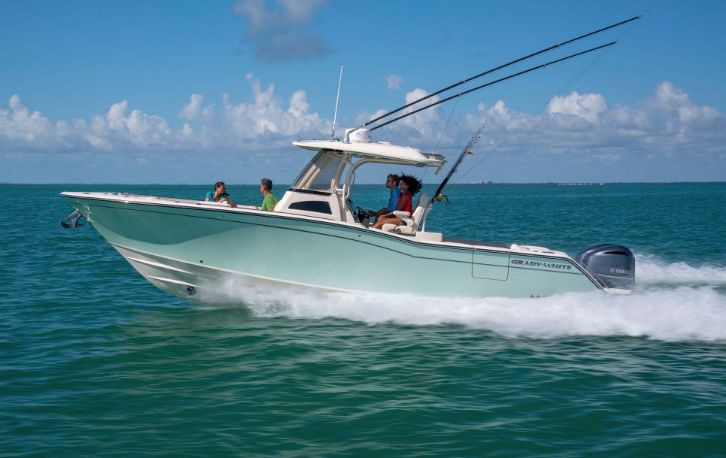
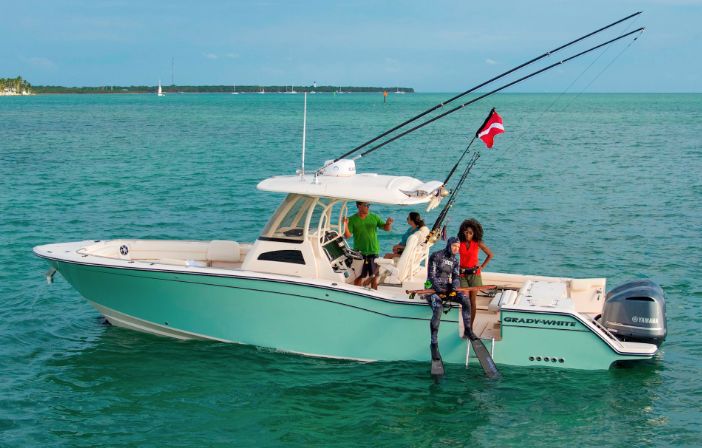
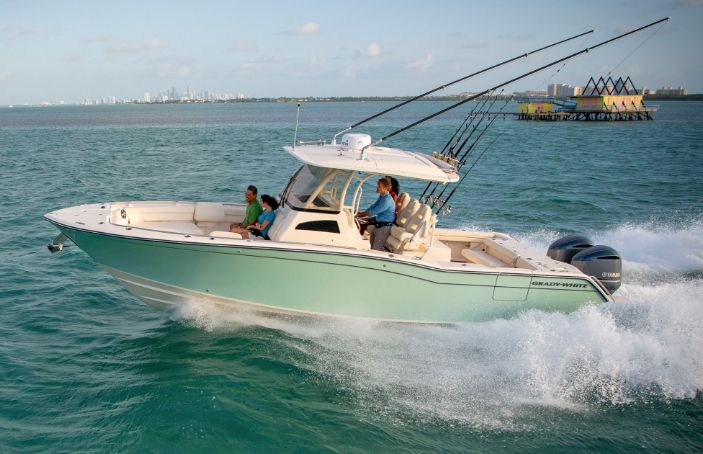
The Grady-White Canyon 326 is 33’1” (10.08 m) long with a 10’9” (3.28 m) beam and, she is the largest boat in the Grady-White line to be offered with only twin outboards.
Mission Statement
Grady-White continues to fill in the Canyon line with the 326, the largest twin-engine model in the Canyon fleet. While the Canyon 336 lets owners step up to triples, the 326 maxes out at twin 350-hp Yamaha outboards, making her a more affordable option. She has everything an owner would want for fishing, but also shows a focus on comfort in the bow lounge area and the private head/shower in the console.
Major Features
- Bow and console lounges
- Three-across seating at the helm
- Choice of twin Yamaha outboards
- Full fiberglass hardtop
- Wide-body SeaV2 non-stepped bottom
- Standup shower and head in console
If a crewmember is fighting a fish or just wants to find a comfortable place to sit, it’s easy to move fore and aft on the Grady-White Canyon 326.
Features Inspection
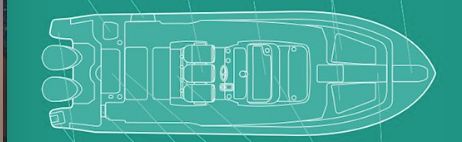
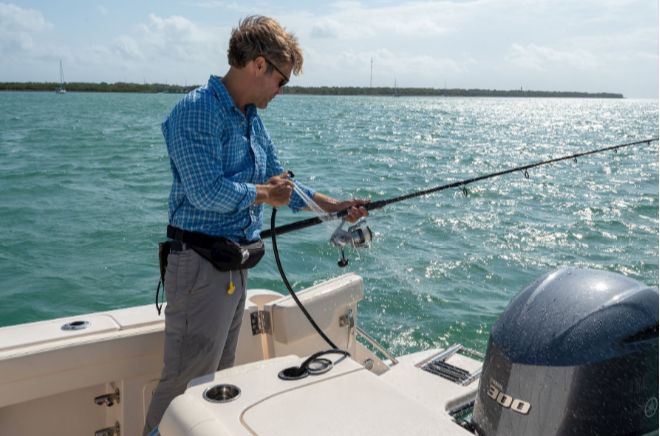
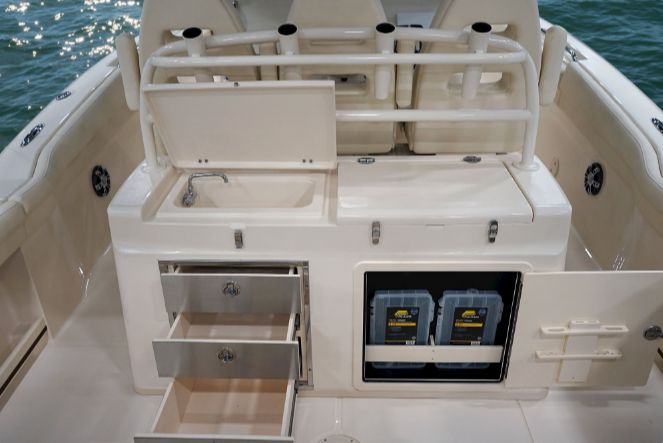
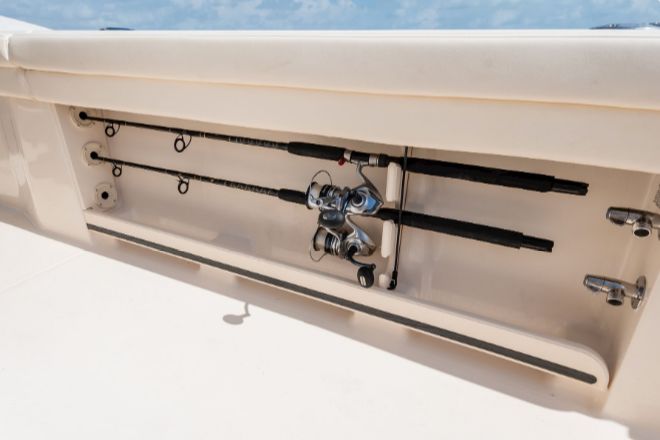
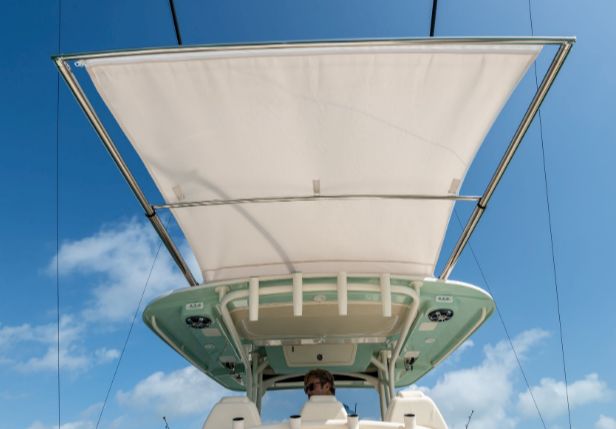
The Cockpit. Starting in the Canyon 326’s cockpit, it measures 8’ (2.44 m) across and 3’6” (1.07 m) fore to aft and has 2’2” (66.04 cm) of depth. Coaming pads ring the inwales and there’s a two-person seat that folds inboard from the stern. In the aft port corner is a 32-gallon (121 L) livewell and in the center is a 318-quart (300 L) insulated fishbox. Taking a closer look at some details, the livewell has a cutting-board top and the hatch opens on a gas strut so an angler can use two hands to retrieve bait. Forward, on the aft side of the helm seat, tension hinges hold up the hatch for the optional second 38-gallon (144 L) livewell, eliminating the need for struts. Alongside is a sink with a cutting board hatch and storage for Plano-style tackled boxes plus a tool rack. Our test boat also had the optional drawer-style refrigerator. To port, our test boat had a side boarding door and aft to starboard is a gate that leads to the stern, including the swim platform and four-step boarding ladder. Just ahead to starboard, the battery switches and circuit breakers are in their own locker. In the starboard gunwale, there are racks for rods and long-handled equipment plus fresh and raw-water washdowns. Overhead, our test boat had the optional SureShade retractable sun awning.
The Canyon 326’s cockpit shows the mix of fishing and cruising amenities from the livewell to the foldout seat and pull-up shower.
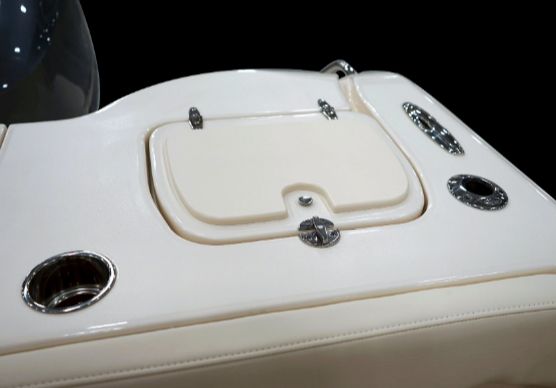
Showing the details we expect from Grady-White, the livewell hatch has a cutting-board on the hatch.
In addition to opening on a gas strut, the livewell hatch is a thick rubber gasket to keep it from rattling when closed.
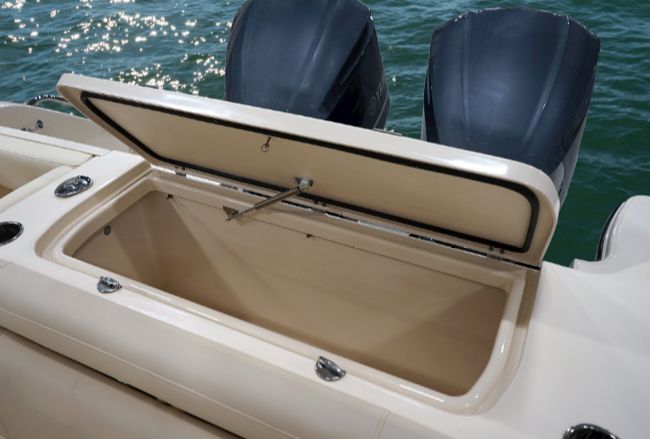
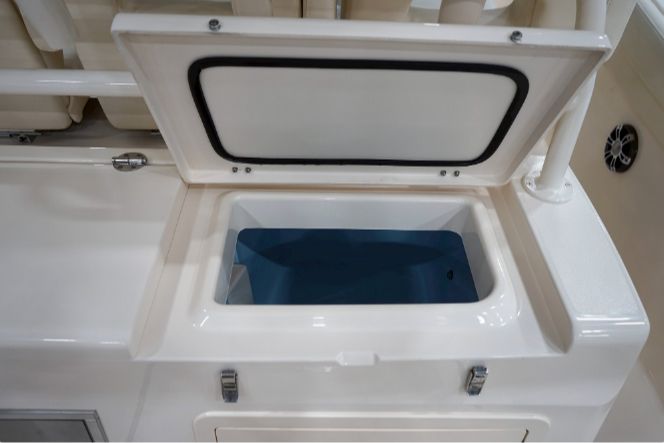
In addition the accessories we see here, the aft fishbox has one more important feature, it is lighted.
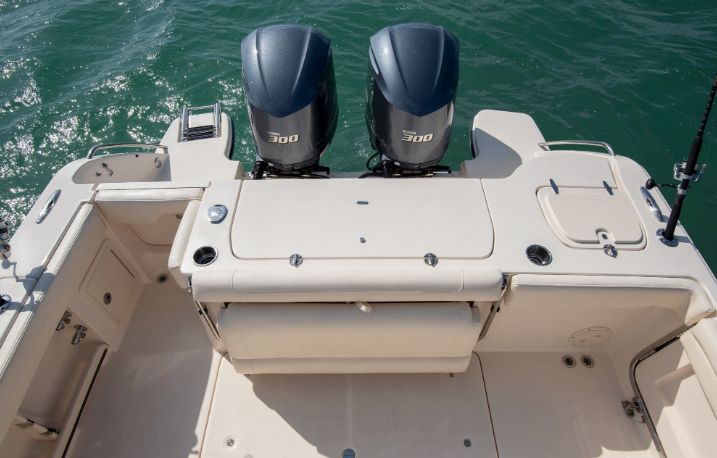
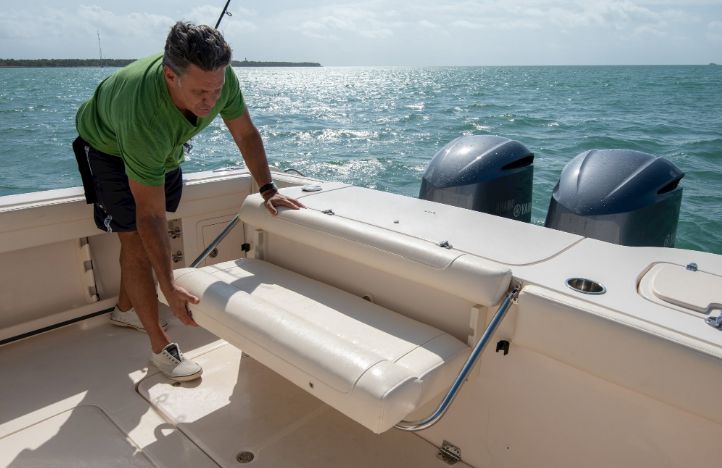
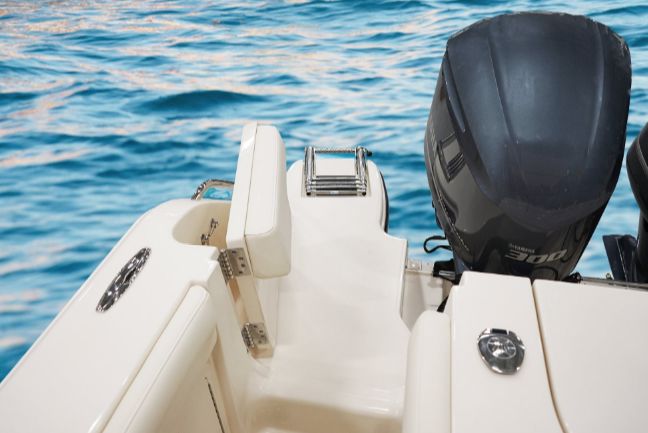
To make the run to the fishing grounds more comfortable, a seat folds out of the stern.
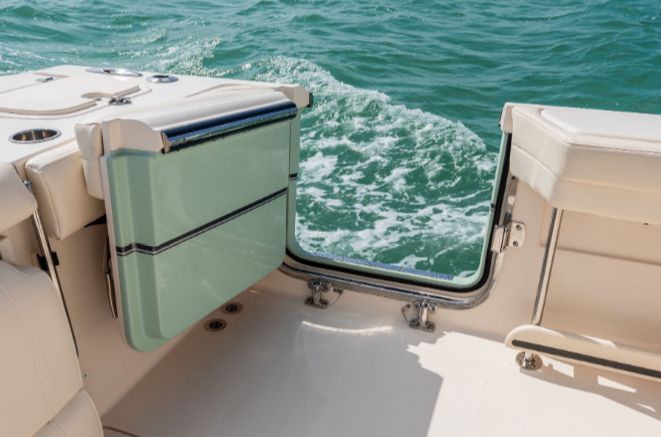
The port cockpit door can be used for hauling in a big tuna or, a ladder can be installed to facilitate boarding for divers or snorkelers.
The hullside door to port makes it much easier for a spear-fisherman to get in and out of the boat.
The aft transom gate leads to the swim platform and four-step stainless-steel boarding ladder.
In the passageway to the stern is a pull-up shower.
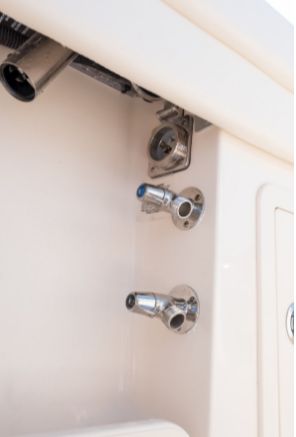
For a larger cleanup job, there are fresh and raw-water washdowns in the starboard gunwale.
The rigging station includes dedicated tacklebox storage and tool racks on the inside of the cabinet doors.
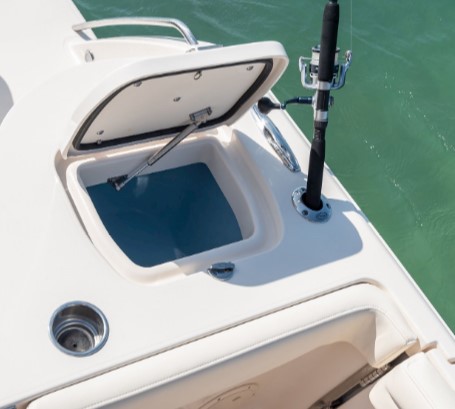
Grady-White uses tension hinges on the rigging station livewell hatch, eliminating the need for a gas strut, which reduces clutter in a compact area.
To starboard in the cockpit, there’s rod storage and notice the toerails that provide extra security for anglers.
The retractable SureShade awning could be a worthwhile option for folks who spend long days on the water.
Mechanical Locker. With the aft bench seat folded into the stern, a hatch in the cockpit deck opens on two gas-assist struts to provide access to the mechanical equipment. Inside are two battery sets and the charging system, twin transducers and thru-hull pickups with remote seacock handles.
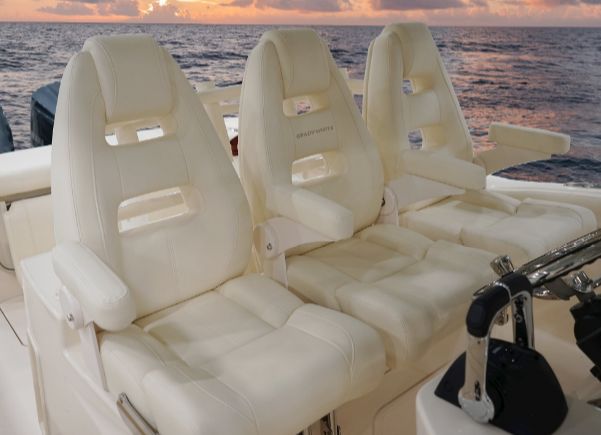
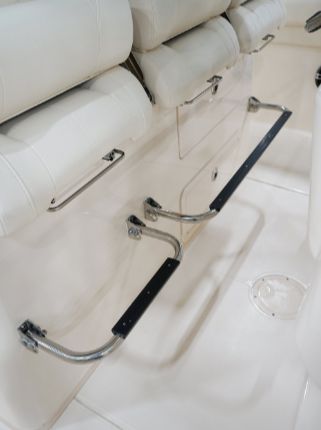
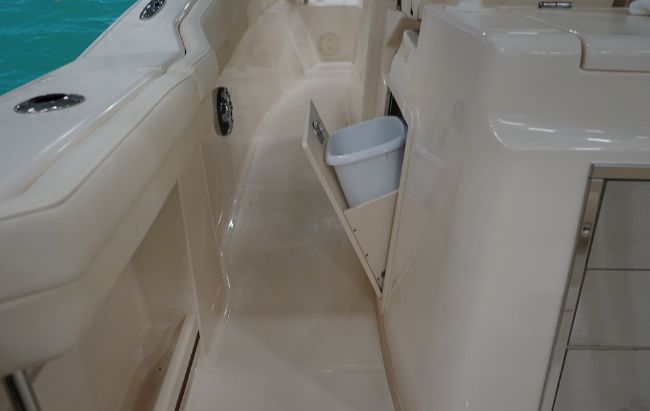
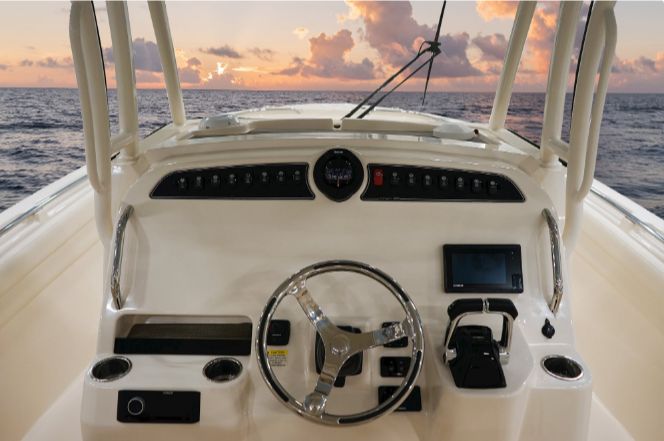
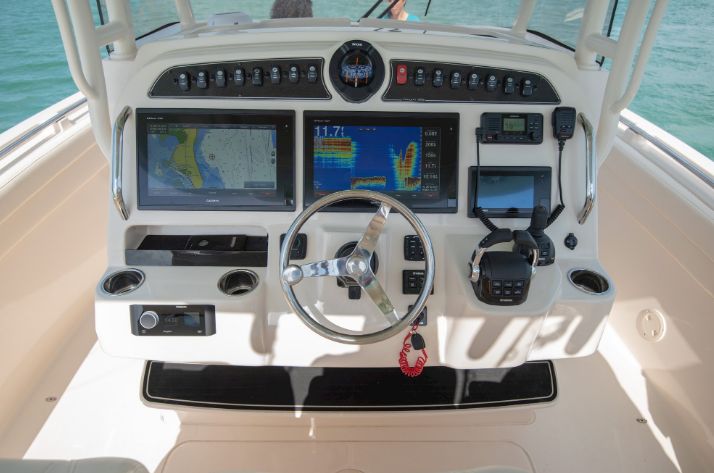
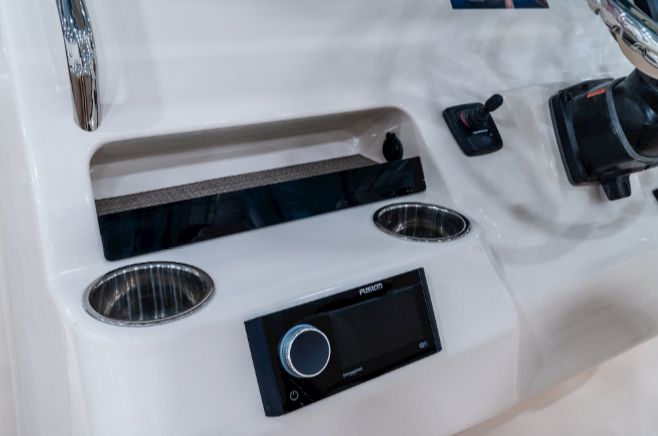
The Helm. At the Canyon 326’s helm, the seats adjust fore and aft and have folding bolsters and armrests. Footrests on the base of the helm seats console fold out and abaft are two storage drawers. In the port side of the seat base there’s a fold-out wastebasket. At the dash, the steering wheel is centrally positioned with the compass in-line and accessory switches on each side. There’s a shallow cushioned storage tray on the top of the console. The vertical electronics flat has space for two 17” (43.18 cm) multifunction displays and outboard to starboard are the VHF radio and Yamaha engine display. Aft are the Helm Master joystick and digital controls with the trim tab buttons with an integrated position indicator just inboard. To the left of the wheel, there’s a small compartment with a fiddle rail and USB plugs, the Fusion Apollo stereo and the optional bow thruster joystick.
The captain and two companions can adjust the helm seats to the individual’s liking.
Fold-out footrests on the helm-seat console add to the comfort.
The wastebasket tucks into the helm-seat base so it’s out of the way when it’s not needed.
It’s rare that we get to see a dash panel without the electronics, but this photo provides a look at the Canyon 326 in its base configuration.
Here we see the twin 17” (43.18 cm) multifunction displays set with the chart to the left and water depth to the right.
To the left of the wheel, there’s a padded tray and USB plug to take care of charging smart phones.
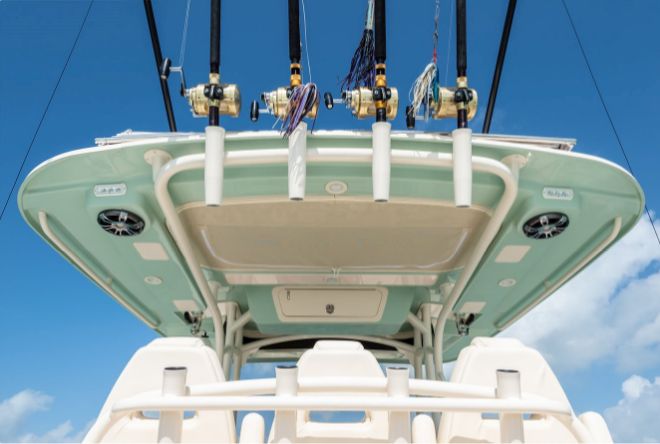
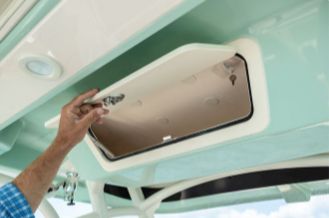
The Hardtop. Taking a look overhead, it’s easy to see that Grady-White engineers went the extra mile to make sure the hardtop frame integrates cleanly with the console and wraparound windshield. An electronics box is forward with zippered lifejacket storage aft. LED lights are integrated into the underside and aft are twin Fusion speakers. Forward, our test boat had the optional outriggers.
Our test boat’s hardtop had the optional colored gelcoat to match the hullsides, which gives the boat a custom feel.
The electronics box in the hardtop can help save space at the dash.
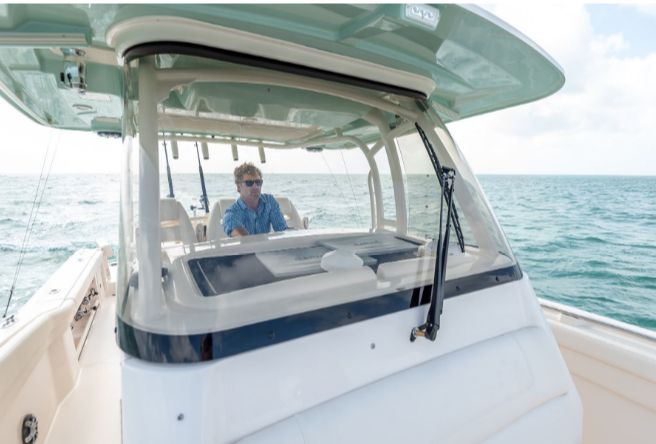
The windshield wraps right around the hardtop stanchions, providing the captain with an unobstructed view.
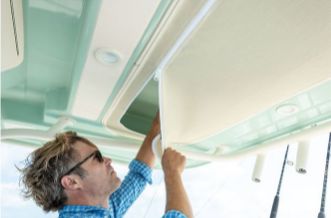
Soft items such as lifejackets or towels can be stowed in the zippered compartment on the underside of the hardtop.
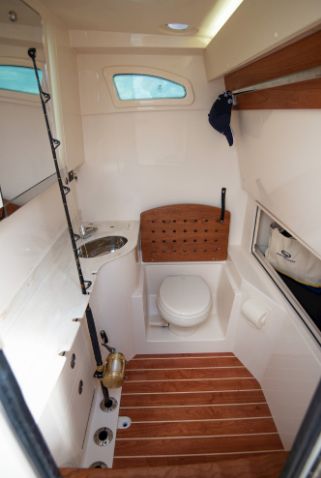
The Console. Forward of the helm, in the console, the private head has 6’2” (1.88 m) of standing headroom and clearance from the top of the toilet is 4’8” (1.42 m). Inside the compartment, there’s a mirror, 12-volt DC switches and a recessed stainless-steel sink with a pull-out faucet. Grady-White also provides a rack for four fishing rods plus a storage drawer and dedicated slots for Plano tackleboxes.
The private head compartment has a seat that folds down over the toilet so a person can sit down and take a shower with the pull-up faucet.
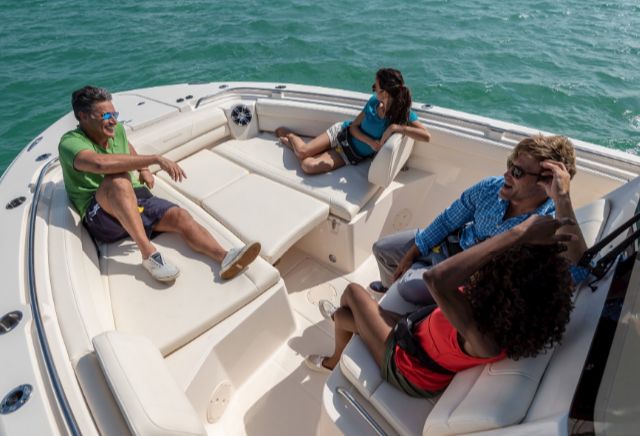
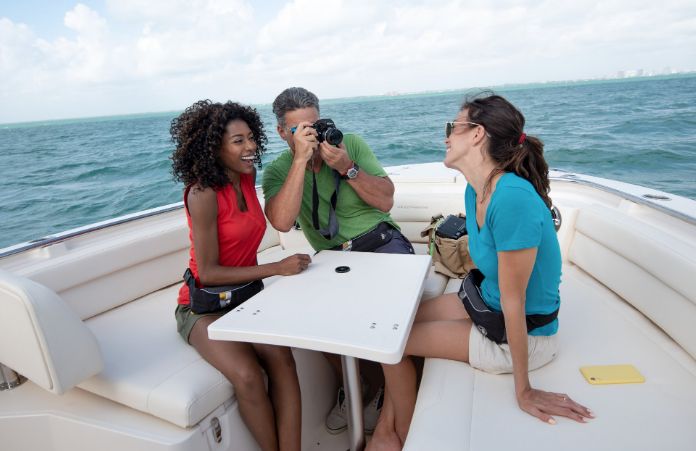
The Bow. The passageway between the console and the gunwale is 21” (53.34 cm), an expansion of 4” (10.16 cm) compared to the space between the helm seats and the gunwale. A recessed rail leads forward to the bow area that has more of a cruising feel. The console seat measures 45” (1.14 m) across and optional bow lounges are 56” (1.42 m) long. Bow depth is 3’1” (.94 m) and a table can be set up in this area. Backrests for the bow seats fold into the gunwale for easier passage.
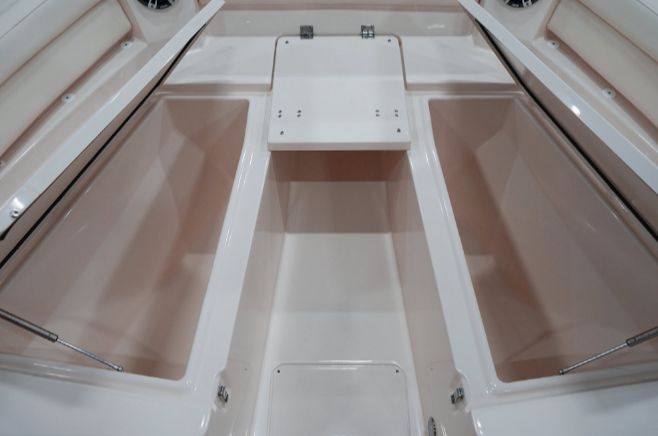
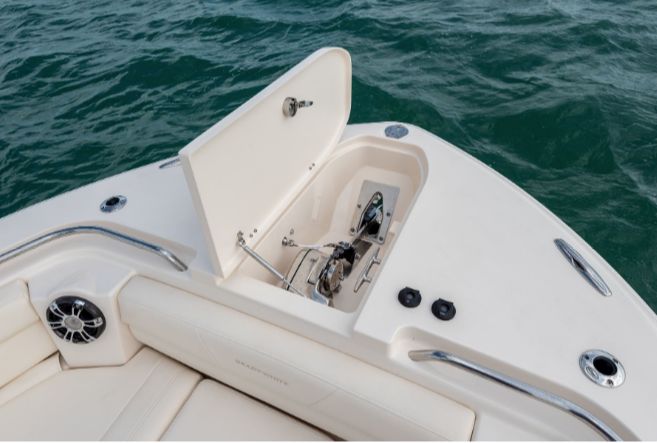
Remove bottom cushions for the bow seats and the area becomes a casting deck that measures 7’4” (2.24 m) wide and 5’ (1.52 m) fore to aft. Insulated fishboxes have 180 quarts (170 L) of capacity. In the foredeck, the anchor locker hatch opens on a stainless-steel strut and has a turn-and-lock latch. Inside are the Lewmar Pro Fish windlass, an 8” (20.32 cm) cleat for the rode, and the roller that leads through the stem. The switches for the windlass are on deck to starboard of the locker hatch.
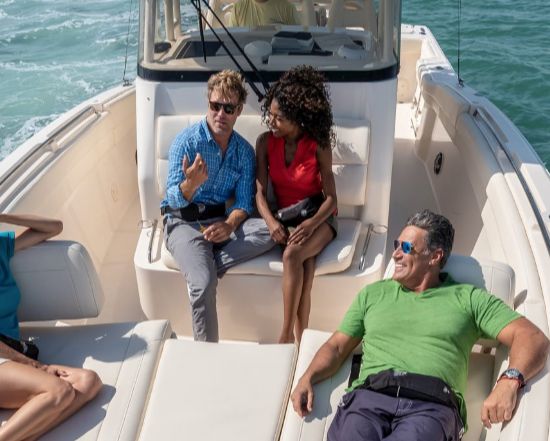
The seat on the front of the Canyon 326’s console has space for two and grabrails on each side if the ride gets bumpy.
With the backrest in place, the starboard bow seat is set up for forward-facing travel, while the port side is folded out of the way for easier passage to the stern.
An optional table adds to the versatility of the bow.
Beneath those comfortable lounges, the Canyon 326 is still a fishing boat at heart with twin insulated fishboxes ready for the day’s catch.
The windlass is in the foredeck below a hatch, but notice that the switches are outside so the hatch does not have to be raised to use the grounding tackle.
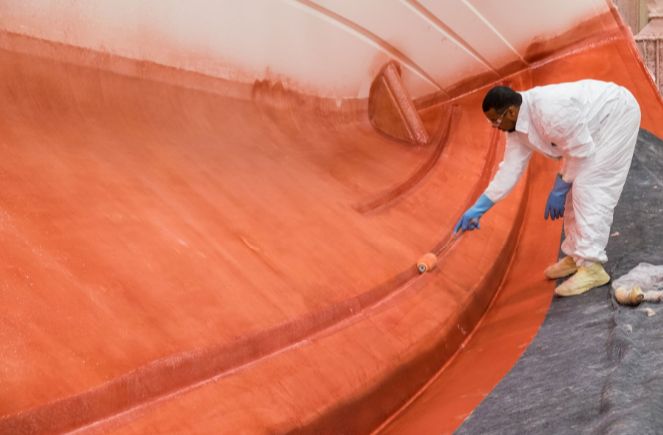
Construction. Grady-White builds the 326 with all hand-laid fiberglass and a wood-free stringer and bulkhead grid backed up with aluminum supports. The boat is also filled with flotation foam to ensure that she is unsinkable.
All Grady-White boats are built with hand-applied materials.
The Numbers. The Grady-White Canyon 326 measures 33’1” (10.08 m) long with a 10’9” (3.28 m) beam and a draft of 2’ (66 cm). Empty weight is listed at 8,500 lbs. (3,856 kg) and with two people, 210 gallons (795 L) of fuel and test equipment on board, we had an estimated test weight of 11,716 lbs. (5,314 kg).
With triple 300-hp Yamaha four-stroke outboards spinning 15 ½” x 17” (37.1 cm x 53.3 cm) SWS2 three-blade stainless-steel propellers at a maximum rpm of 6000, we hit a top speed of 49.0 mph. Best cruise came at 3500 where we saw 25.3 mph and a fuel burn of 16.5 gph, giving us 1.5 mpg and a range of 452 statute miles while holding 10 percent of the boat’s 327-gallon (1,238 L) fuel capacity in reserve. For those interested in trolling speed data, we recorded 3.8 mph at 600 and a fuel burn of 1.2 gph, which translated into 3.2 mpg. At 1000 rpm, speed was 6.0 mph with a fuel turn of 2.6 gph for a mpg rating of 2.4. In acceleration tests, the Canyon 326 planed in 3.2 seconds and ran through 20 mph in 4.8 seconds and through 30 in 7.1 seconds.
The Canyon 326 gets close to a mile per gallon at 3500, 4000 and 4500 rpm so she can make efficient progress at a variety of rpm and trim settings.
Handling
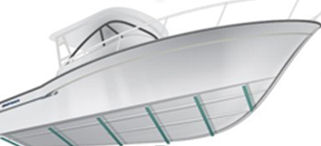
Like all Grady-Whites, the Canyon 326 rides on the SeaV2 hull designed by C. Raymond Hunt. The deadrise sharpens gradually from the stern to the bow to create a bottom that provides even lift across the surface. She has a sharp forward entry to help the boat cut through waves. In our maneuverability tests, the boat acquitted herself well, carving smoothly through turns in either direction. The captain can get as aggressive as he wants and the Canyon 326 will oblige.
The bottom design is tried and true classic V-bottom.
Options to Consider
- Bow thruster
- Cockpit grille in lieu of sink
- Outrigger kits
- Ski pylon (in lieu of transom rod holder)
Observations
The Grady-White Canyon 326 has a big feeling to it, thanks to a beam that’s about a foot wider than competitive models from Yellowfin and Contender. That enhances her fishing and cruising capabilities and creates a more comfortable boat.
Grady-White offers a Canyon 336 that’s basically a foot bigger and maximum power is twin 425-hp outboards or triple 300-hp motors. The 326 is limited to twin 350-hp outboards, which helps keep the prices down on a boat that is more than capable of heading offshore.
Test Video Summary
Overview
The Grady-White Canyon 326 is a larger, offshore-capable center console designed to be great for fishing and family-friendly as well. BoatTEST’s Captain tested her with twin 300-hp Yamaha four-stroke outboards, her standard power.
“It appears that the Canyon 326 is definitely a great boat for moving up from a smaller center console, or even down from a larger fishing machine.”
Mission And Intended Owner
- Built To Do: Offshore fishing and family boating
- Designed For: Owners moving up from a smaller center console or down from a larger fishing machine
- Locus Of Operation: Offshore
Design Overview
- Hull: Deep V with a 20-degree deadrise
- Beam: Wide 10-foot, 9-inch beam carried far forward, creating wide bow seating
- Hardtop Supports: Integrated into the console rather than taking up side-deck space
- Drainage: Every rod holder, drink holder, livewell and fish box drains overboard
- Running Attitude: A natural 5-degree bow-high attitude
Specifications
- Length Overall: 33 feet, 1 inch
- Beam: 10 feet, 9 inches
- Draft: 24 inches
- Empty Weight: 8,500 pounds
- Fuel Capacity: 327 gallons
- Deadrise: 20 degrees
- Cockpit: 8 feet by 3.5 feet, or 28 square feet
- Cockpit Depth: 26 inches
- Bow Depth: 37 inches
- Side Clearance: 17 inches beside the leaning post, 21 inches at the back of the console, 20 inches at the front
- Bow Casting Deck: 7 feet, 4 inches max width by 5 feet
- Rod Holders: 24 total
Test Conditions And Test Weight
- Sea State: Flat calm
- Load: 64% fuel, two people and optional accessories
- Test Weight: 11,716 pounds
Performance
- Tested Power: Twin 300-hp Yamaha four-strokes turning 17-pitch propellers
- Optional Power: Up to twin 350s
- Top Speed: 49 mph at 6,000 rpm
- Best Cruise: 25.3 mph at 3,500 rpm, burning 16.5 gph
- Fuel Economy At Best Cruise: 1.5 mpg
- Range At Best Cruise: 452 miles, holding a 10% reserve
- Trolling: 6 mph at 1,000 rpm burning 1.2 gph, and 8.5 mph at 1,500 rpm burning 4.2 gph
| RPM |
MPH |
GPH |
MPG |
Range (Miles) |
| 1,000 |
6 |
1.2 |
— |
— |
| 1,500 |
8.5 |
4.2 |
— |
— |
| 3,500 |
25.3 |
16.5 |
1.5 |
452 |
| 6,000 |
49 |
— |
— |
— |
Acceleration:
- Time To Plane: 3.2 seconds, with a 10-degree bow rise
- 0–20 mph: 4.8 seconds
- 0–30 mph: 7.1 seconds
Sea Trial And Handling
- Wakes: Clean penetration with no slap
- Spray: Kept wide and low, with none taken aboard
- Ride: Solid, feeling like a much heavier boat
- Turns: Responds well to the helm and stays planted, with no adverse slide or heel-over
- Chine Walk: None
- Trim Tabs: Never needed
- Steering: Hydraulic with power assist
- Docking: Helm Master joystick gave excellent controllability, even though its programming wasn’t fully dialed in
“She feels like a much heavier boat, with the hull giving such a solid ride.”
“I found excellent controllability, even though the boat was rushed to get to us for the test and the programming wasn’t quite dialed in on the stick yet.”
Engine Room Or Mechanical Compartment
- Access: Lift the transom seat to reach the deck hatch over the mechanical compartment
- Contents: Engine start and house batteries, the charging system, dual transducers and through-hull pickups
- Seacocks: Remote seacock arms connected to the ball valves
- Battery Switches: Just inside the entry to the cockpit
- Engine Flush: Freshwater flush quick-connects at the cockpit walk-through
- Overhead Height: 6 feet, 2 inches of headroom in the head, with 4 feet, 8 inches of sitting headroom
- Cockpit Depth: 26 inches
“The battery switches are just inside the entry to the cockpit, right where they belong.”
Features Inspection
The Helm
- Compass: In line with the center-mounted helm
- Switch Panels: Soft-touch, non-glare panels on both sides, with the horn in red
- Displays: Twin 17-inch displays, with the VHF to the right
- Controls: Yamaha engine display, optional Helm Master joystick, engine control binnacle, trim tabs and engine start/stops
- Bow Thruster: Joystick control
- Storage: Cubby with connectivity to the left
- Audio: Fusion Apollo series stereo
- Steering Wheel: Rubber grips front and back, a steering knob and a tilt base
- Console Sides: Beverage holders, USB charging ports and stainless grab handles
- Hardtop: Integrated handholds, an electronics box, life jacket storage, speakers, tri-color overhead lighting, a forward spreader light and optional outriggers
- Windshield: Full-height tempered glass, with just a hint of distortion at the curved sides, and a standard pantograph wiper with washer spray
- Helm Seating: Three across, each adjustable with flip armrests, bolsters and footrests
- Storage: Drawers behind the footrests
- Footrest: Molded into the bottom of the console
Anchor Locker And Ground Tackle
- Access: Lift the forward seat, putting the gear at standing level
- Hatch: Turn-to-lock latch and a support strut
- Cleat: 8-inch cleat to secure the rode and take the load off the windlass
- Anchor: Rode runs through the stem roller
- Controls: Just to starboard
- Rode Access: Through a hatch below
- Washdowns: Fresh and raw-water connectors
- Cleats: Three 8-inch pull-up cleats on each side
Boarding Amenities
- Dive Door: Standard hull-side door to port, with an ergonomic latch, a recess in the aft bolster and a strap to hold it open
- Dive Ladder: Stores under the cockpit deck hatch in the port quarter
- Swim Platform Access: Same easy-release latch as the dive door
- Reboarding Ladder: In line with the walk-through, with a long grab rail ahead
- Lighting: Courtesy lights under both platforms
- Freshwater Shower: At the walk-through
- Ski-Tow Pylon (Optional): Pull-up, in the center of the transom
“To the port side is a welcome addition to the standard list, a hull-side dive door.”
Cockpit Arrangement And Equipment
- Bolsters: Padded all around
- Under-Gunwale Storage: To starboard
- Toe Rail: For support when fighting fish
- Washdowns: Fresh and raw water to starboard
- Livewell: 32 gallons, with a gas-assist strut
- Transom Cooler: 318-quart insulated and lighted cooler, with a gas-assist strut, draining overboard
- Transom Seat: Among the easiest to deploy and stow
- Livewell (Optional): 38 gallons, replacing a standard cooler
- Sink: With a cutting board, and tool storage behind the door
- Refrigerated Drawer (Optional): Replaces the standard three stainless steel drawers
- Rod Holders: Four low and high at the station, part of 24 total aboard
- Lighting: Spreader lights overhead
- SureShade (Optional): Sun protection for the cockpit
- Fire Extinguisher: Dedicated recess to starboard
- Trash Receptacle: To port
“There’s a transom seat that’s among the easiest to deploy that I’ve seen, and it stows away just as easily. Well done there.”
“A padded mat at the gunwales would be nice to protect the reels.”
Bow Arrangement
- Console Seat: 45 inches wide, with a high seatback
- Grab Rails: With integrated beverage holders, plus a full-length rail inside the cap rail
- Loungers: Two, 56 inches long, with bolsters as armrests and seatbacks that swivel out of the way
- Seat Width: 33 inches, tapering to 18 inches forward
- Footwell: 21 inches
- Fish Boxes: 180-quart insulated boxes under both sides, with gasketed hatches and support struts
- Table: Pedestal table in the footwell, which lowers with a center cushion to create a sun pad
- Casting Deck: With all cushions removed, a 7-foot, 4-inch by 5-foot casting deck with molded non-skid
- Speakers: Forward-facing, beside the front seat
“It’s here where we see the real comfort on this boat.”
Interior Spaces
Head Compartment:
- Entry: Door to starboard, with 12-inch and 15-inch steps down
- Headroom: 6 feet, 2 inches standing, 4 feet, 8 inches sitting
- Mirror: On the aft bulkhead, with lights on both sides
- Electrical: 12-volt mains alongside
- Counter: Corian, with notches for rods that drop into holders below
- Sink: Single-basin stainless steel, recessed, with a pullout sprayer to rinse rods
- Decking: Cherry and holly
- Toilet: Porcelain, with a teak seat over the back
- Storage: Tackle storage at the forward bulkhead, plus a garage-door-style compartment that holds the table pedestal
- Towel Bar: Secure enough to use as a grab rail
- Hooks: For hanging wet gear
- Light: Overhead lighting and side windows
“The head is accessed from the door to the starboard side, and it’s no afterthought, drop-in porta-potti arrangement.”
General Construction
- Everything drains overboard
- Hatches finished with gaskets and support struts
- Non-skid molded into the bow casting deck
Advantages And Disadvantages
Advantages
- Solid ride that feels like a much heavier boat
- Planted in turns with zero chine walk
- No trim tabs needed
- Dry, with spray kept wide and low
- 452-mile range at best cruise
- Standard hull-side dive door
- Very comfortable bow with wide seats and 180-quart fish boxes
- A real head with 6'2" headroom, a porcelain toilet and a Corian counter
- Easy-deploying transom seat
- Battery switches and seacock controls are easy to reach
Disadvantages
- No padded mat at the gunwales to protect reels
- A hint of distortion at the curved sides of the windshield
- 10-degree bow rise when coming up on plane
- Helm Master joystick, SureShade, 38-gallon livewell, refrigerated drawer, ski pylon and outriggers are optional
- Test day was flat calm, so rough-water handling was not shown