Brief Summary
The Boston Whaler 380 Outrage has a 23-degree deadrise at the transom, near the max available in production boats, and this results in an exceptional ride offshore -- as can be seen in our test video. Our test of the 380 Outrage was in some of the roughest water we have tested in and the 380 took it easily in stride. With an 11' 8" (3.56 m) beam and an equipped weight of over 20,000 lbs. with triple 350 Mercury Verados and a 23-degree deadrise, she felt like a far larger boat.
Test Results
| RPM |
MPH |
Knots |
GPH |
MPG |
NMPG |
SM |
NM |
dBa |
| 600 |
3.9 |
3.3 |
1.9 |
2 |
1.7 |
795 |
691.1 |
62 |
| 1000 |
6.3 |
5.4 |
3.4 |
1.9 |
1.6 |
743 |
645.9 |
65 |
| 1500 |
8.2 |
7.1 |
5.4 |
1.5 |
1.3 |
606 |
527.1 |
81 |
| 2000 |
10.1 |
8.8 |
8.4 |
1.2 |
1 |
480 |
417.5 |
72 |
| 2500 |
11.5 |
10 |
13.9 |
0.8 |
0.7 |
331 |
287.8 |
74 |
| 3000 |
11.4 |
9.9 |
20.2 |
0.6 |
0.5 |
225 |
195.3 |
78 |
| 3500 |
17.4 |
15.1 |
26.1 |
0.7 |
0.6 |
266 |
231.5 |
81 |
| 4000 |
29.3 |
25.4 |
32.7 |
0.9 |
0.8 |
359 |
312 |
85 |
| 4500 |
36.1 |
31.3 |
41 |
0.9 |
0.8 |
352 |
306.2 |
86 |
| 5000 |
39.9 |
34.7 |
51.1 |
0.8 |
0.7 |
313 |
271.8 |
89 |
| 5500 |
45.3 |
39.4 |
71.5 |
0.6 |
0.6 |
254 |
220.5 |
87 |
| 6000 |
48.8 |
42.4 |
88.6 |
0.6 |
0.5 |
220 |
191.7 |
90 |
| 6200 |
50 |
43.4 |
91.2 |
0.5 |
0.5 |
219 |
190.7 |
91 |
Specifications
| Length Overall |
38' / 11.58 m
|
| Beam |
11' 8"
3.56 m
|
| Dry Weight |
14,500 lbs.
6,577 kg
|
| Tested Weight |
20,094 lbs.
9,114 kg
|
| Draft |
23.5"
0.6 m
|
| Deadrise/Transom |
23 deg.
|
| Max Headroom |
Open
|
| Bridge Clearance |
16' 4"
4.98 m
|
| Weight Capacity |
5,214 lbs.
2,365 kg
|
| Person Capacity |
16
|
| Fuel Capacity |
445 gal.
1,684.5 L
|
| Water Capacity |
60 gal.
227 L
|
| Total Weight |
20,094 lbs.
9,114 kg
|
Acceleration Times & Conditions
| Time to Plane |
3.8 sec.
|
| 0 to 30 |
9.3 sec.
|
| Ratio |
N/A
|
| Props |
16” (40.6cm)x17" (43.18cm) Enertia Eco
|
| Load |
2 persons, 4/9 load, no water, 2,050 lbs. of gear
|
| Climate |
60 deg., 45 humid.; wind: 20-30 mph; seas: Light chop
|
Engine Options
Contents of Report
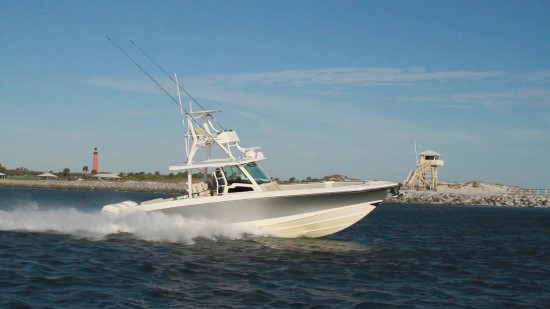
Boston Whaler’s newest Outrage is a compilation of everything customers said they wanted… and more.
Overview
Boston Whaler has retired the 370 Outrage while it was among the most popular of the company’s lineup. And it did so not by making the usual adjustments to the existing model that we typically see, but from starting over with a clean sheet of paper. In doing so, it created a new and revitalized battle wagon that has many improvements both below and above the waterline. The most significant, in our eyes, is a completely new running surface. This could either make or break the legendary handling characteristics that Boston Whaler’s are so well known for, so let’s start with those changes and what they resulted in.

New Hull Design
With the world adopting a “don’t fix it if it ain't broke” mentality, Boston Whaler begs to differ. This new hull design is significant.
First, the obvious… the designers increased the deadrise from 15-degrees to a whopping 23-degrees. The design then focused on deadrise distribution to get more deadrise midship for a more comfortable ride at the helm. Then added a padded keel with minimal rocker angle to help the boat get on plane easily, minimize bow rise, and increase visibility at all speeds. Finally, there’s the incorporation of the “dynamic running surface” trim tab system. Larger triangular planes integrated in the running surface increase lift and effectiveness compared to traditional transom-mounted tabs, reduced drag and allow for a cleaner flow off the tabs as compared to transom-mounted tabs.
The Boston Whaler 380 Outrage has an LOA of 38’ (11.58 m), a beam of 11’8” (3.56 m) and a draft of 23.5” (59.69 cm). With an empty weight of 14,500 lbs. (6,577 kg), 44% fuel, two people and test power, plus nearly 1 ton (2,000 lbs. / 907 kg) of optional features added on, we had an estimated test weight of 20,094 lbs. (9,114 kg).
We tested with Mercury’s new cruise assist system controlling the engine speeds and all the engines were set on auto trim… and both systems performed flawlessly. So… for our first time testing with everything on full auto, and the triple Mercury 350 Verados turning 16x17 (40.6 cm x 43.2 cm) Enertia Eco props.
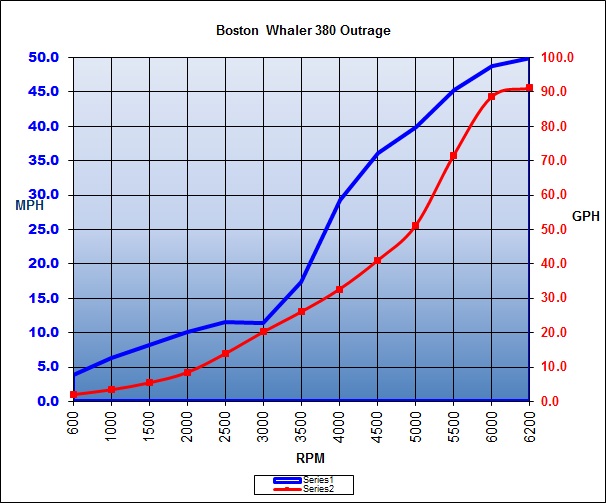
We reached our top speed of 50 mph at 6200 RPM. The best cruise was measured at 4000 RPM and 29.3 mph. At that speed the 32.7 GPH fuel burn translated into .9 mpg and a range of 359 miles, all while still holding back a 10% reserve of the boat’s 445 gal. (1,685 L) total fuel capacity.
And remember, this performance is with the added weight of the many options… the tower and sea keeper gyro among the heaviest.
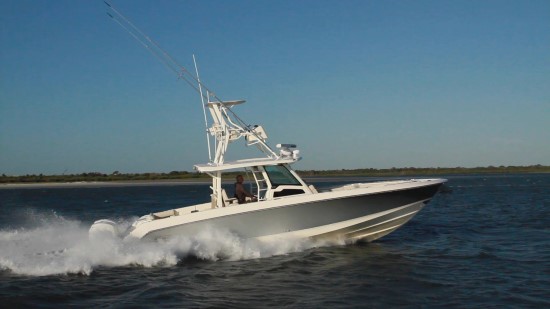
We got a top speed of 50 mph and a best cruise of 29.3 mph.
Handling
As for her handling, we tested in protected water and got a good feel for the way the 380 Outrage handles. We found her newly designed hull to be responsive and well mannered in the calm waters of our test area. But that just doesn’t tell the full story. This is a Boston Whaler, so what matters is how she handles offshore.
So we took her out in winds blowing 30 to 35 mph with 8' to 10' rollers and had at it. Turns out this 380 outrage handles with the grace of the 420… solid, predictable and well mannered. It was unbelievable. There was never a moment where we felt compromised, and indeed we had no desire to turn around and head back into the protected inlet.
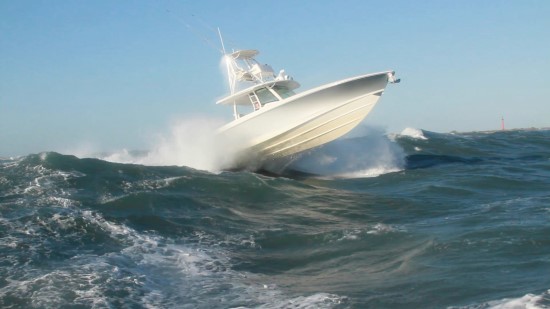
We had no trouble bursting through the heavy surf on test day… and the re-entry was gentle thanks to the increased deadrise and how it distributes the forces across the entire hull.
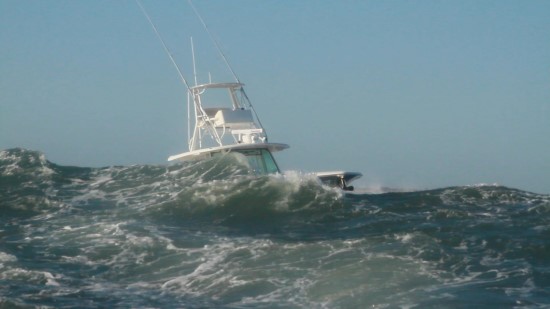
They never look like the heights we’re describing until the boat is hidden by them.
She has a narrow entry giving clean penetration, and that new 23-degree deadrise makes for a soft re-entry with water being thrown wide and low. She’ll still take spray, the wind being what it is, but it’s minimized from this new design. And the ability to take the dynamic tab system and lower the nose into this heavy surf is just without equal… and it’s all automatic.
Steady Now
This boat also has a SeaKeeper gyrostabilizer so we powered that unit up for a look. No surprise, it worked great and this is a feature that will not only be appreciated by the families but the fishermen that will be standing for long periods.
Features Inspection by Category
Operations
The ship's 110v electrical panel is protected inside, just at the cabin entry. The 12v panel is behind a hatch to the starboard bulkhead, adjacent to the helm seats, and this space also includes the ignitions that will activate the push to start buttons at the helm.
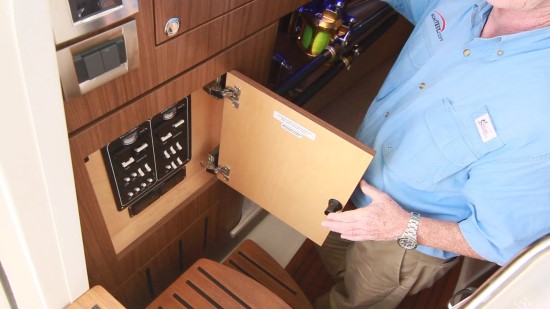
110 V panel is located just inside the entrance to the cabin.
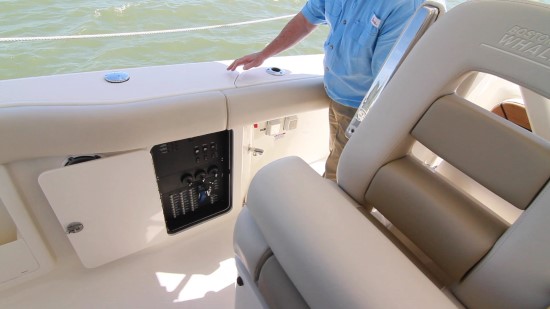
The 12 V panel is located to the starboard bulwarks, adjacent to the helm seat.
Lower Helm
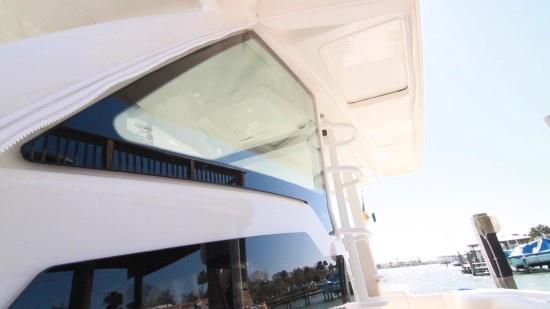
The console profile shares the aggressive new styling the current outrage models posses and it looks great. It’s a very angular and modern design.
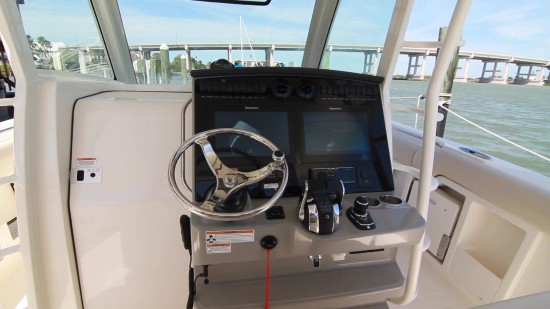
The helm console has an interesting design feature in that its offset to starboard with the actual helm station mounted right on the centerline. This allows for the entrance to the cabin to be located just to the left of the helm.
The helm console is surrounded by tempered glass on three sides and an electrically actuated vent is at the top of the forward windshield. Defrost vents are just behind and this is a feature that we’ve seen forgotten on some other builders' designs. Overhead and facing the operator are the SeaKeeper control panel, the Mercury Active Trim panel controlling the engine trims, the latest iteration of Mercury’s VesselView display, and an opening glove box with tension hinges.
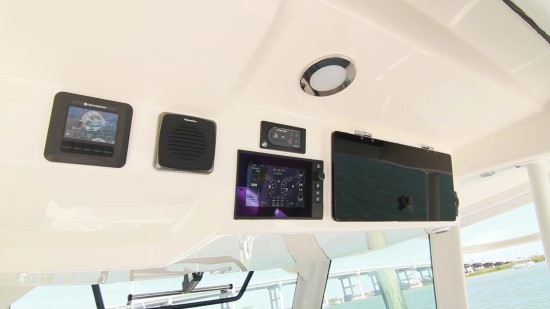
Some of the more sedentary features are moved overhead but are still within reach.
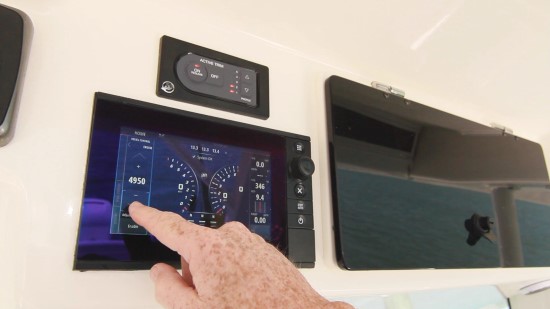
Here we can see the active trim control panel that can also be controlled by this vessel view display. This shot also shows the cruise control being set to specific RPM settings.
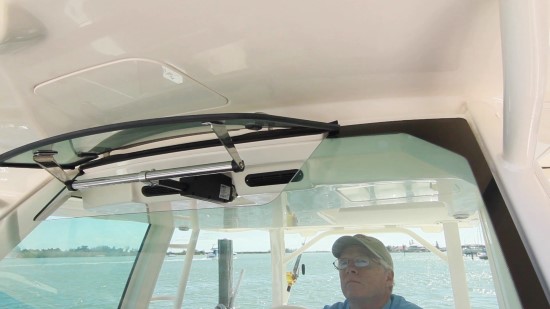
The top of the windshield has an electrically actuated vent and defogger vents are just behind.
The operator, helm, and compass are right on the centerline, in the sweet spot of handling. A soft-touch vinyl dash cover and brow top off the console and Boston Whaler thoughtfully added a welcome space for putting stuff like cell phones that includes an accessory plug and USB port (the requested features begin).
Rocker switches line the top of the panel, heat and ac vents are in the center. To our eye, the most significant switches are the boost switch for the heat and ac (temporarily labeled Acc 2 on our hull #1 test boat) and switch to open the forward vent.
The panel that has been cleaned up significantly over previous models and the glass dash concept features two 165 GS screens mounted into an acrylic backing. Below are the three engine start/stops, the fusion stereo, the remote for the spotlight, the stainless wheel has a convenient steering knob and it’s all mounted to a tilt base.
The automatic trim tabs are alongside, and this hull really made us a fan of those. The digital throttle and shift binnacle is next and then the Mercury JPO or Joystick Piloting for Outboards with its features that include Heading Hold Autopilot, Waypoint Steering, Skyhook, Boathook, and Bow Hook included. Dual footrests are below.
Directly overhead is storage for the full weather enclosure, and this highlights a theme of Boston Whaler storing items near where they will be used. And it’s not lost on us that we still have 6’8" (2.03 m) of headroom under this storage space.
Helm Seats
The seats are three across with each one having individual armrests and bolsters. The captain’s, in the center, is electrically adjustable fore and aft. The port side observer gets a separate flip down footrest since this seat is not at the console. And our vertically challenged test captain loves the flip down elevated deck brought him up six more inches (15.24 cm). In a thoughtful touch, it’s covered with anti-fatigue SeaDecking. With the flip down decking in the lowered position, a panel is exposed that houses the SeaKeeper gyro.
Tower Helm
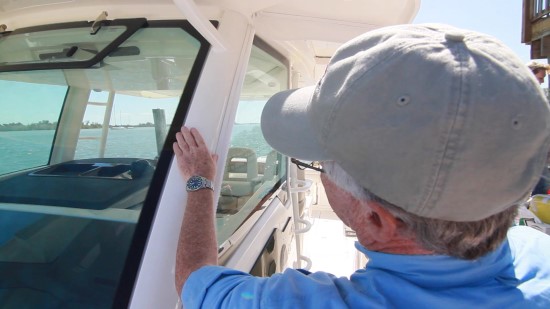
The hardtop and tower supports are integrated into the console so as not to impede on the side deck space.
We access the tower from a set of stairs and a sliding hatch to the port side. This elevated helm is functional and minimalist but still features a small nav display, a Vessel View display, the remote spotlight control, horn, engine start stops, tilt base steering, VHF, DTS engine controls and a second joystick. The doublewide seat has individual bolsters with storage underneath. Outriggers are to the sides and overhead is a protective Bimini providing much-appreciated shade.
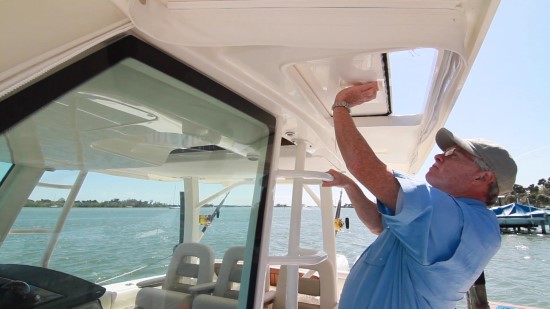
The tower is accessed from a sliding hatch to the port side of the console.
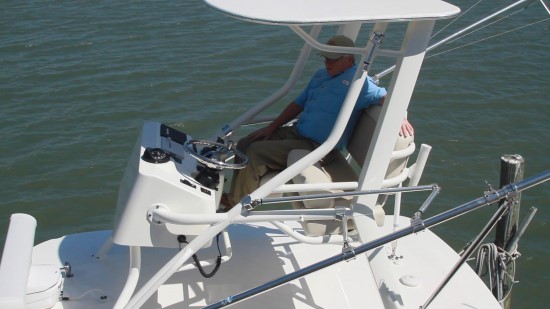
The helm station is well-equipped for spending long times operating the 380 Outrage from this elevated position.
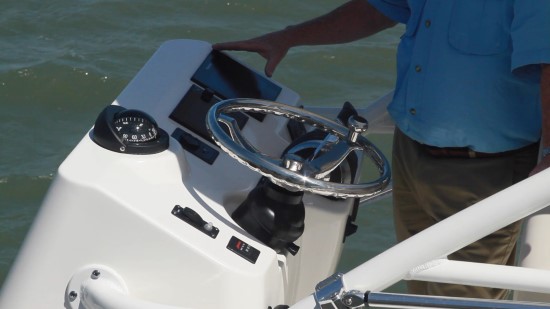
The tower helm even includes a small nav display in the latest Vessel View display.
Ground Tackle
At the foredeck, a hatch concealed the vertically mounted Lewmar windlass. The anchor is mounted through the stem. A cleat is provided for securing the rode. A remote control on a coiled cord mounts to the void area that also houses a washdown spigot and room to access the rode.
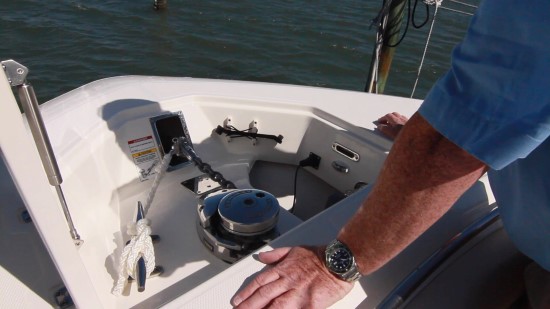
A hatch at the bow conceals the windlass and the anchor that is mounted through the stem.
The hatch cover is finished to both sides, it’s supported with a stainless steel support strut and opens with a turn and lock latch. When closed the entire foredeck is treated with diamond non-skid and includes pull-up cleats and rod holders.
Mechanical Room
Here’s one of our favorite features. We first saw this on Boston Whaler’s and now it’s a theme that’s repeated by other manufacturers. At the cockpit, a deck hatch lifts to reveal a mechanical room with basically all of the mechanical components of the 380 Outrage combined into this one compartment.
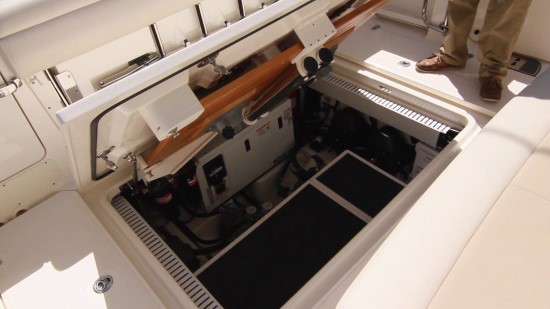
In the center of the deck is a mechanical room that consolidates all of the boats working gear into one location. Notice under the hatch there is storage for the cockpit tables.
There’s a flip-down deck with diamond non-skid that makes it easier to work here. Underneath it are the batteries. Looking around in a clockwise direction we’ve got the fire suppression system, the port fish box macerator pump, the holding tank discharge, the live well pump, two power steering pumps, the battery charger, a freshwater pump, a raw water pump, water manifolds, automatic battery switches and parallels, another power steering pump, three fuel filters, the starboard fish box macerator, the air conditioning pump, the gyro cooling water pump, raw water strainers, the bilge pumps, probably a partridge in a pear tree, oh… and the generator.
Fishing Features
For fishing features, the cockpit measures in at 45 sq. ft. (4.18 sq. m), providing plenty of fighting room. To both sides are huge fish boxes that are refrigerated and macerated. Forward there are spreader lights behind the hardtop, two color courtesy lights, a remote camera and rod holders integrated into the supports.
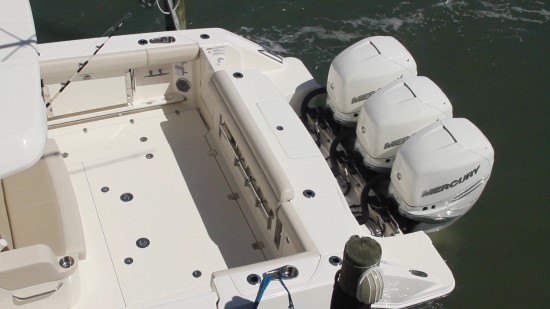
The cockpit features plenty of room to bring the fight to the fish.
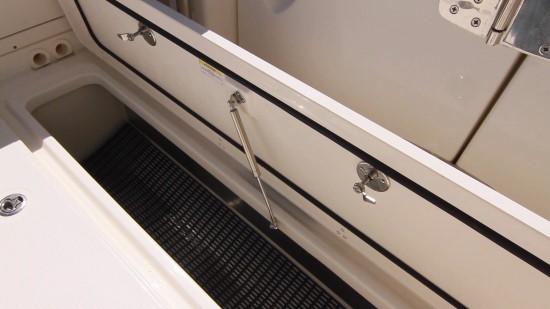
To both sides of the cockpit are large fish boxes that are refrigerated and macerated.
In the quarters, there are 10” (25.4 cm) cleats, washdown spigots, speakers, and cannonball holders integrated into toe rails. A hatch alongside opens to a drawer designed to hold a 5-gallon (18.93 L) bucket. The whole deck is canted to channel water to the twin deck drains to each side.
In the port quarter, the button to the top activates the auto flush system for the engines. Just hook up a single hose and press this switch to flush all the engines out with fresh water. back and forth. We’d like to see an acrylic cover to this. It’s connected to a huge pump that keeps the water well circulated.
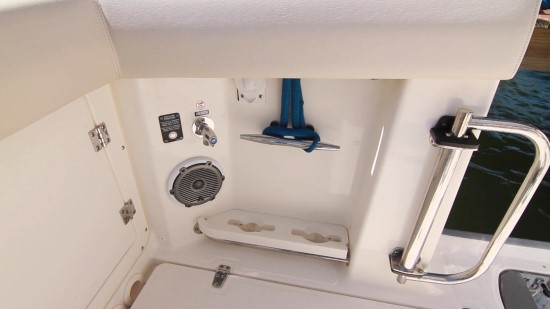
In the port quarter, there are multiple features, including the button to the left of the washdown spigot that facilitates flushing out all of the engines at once.
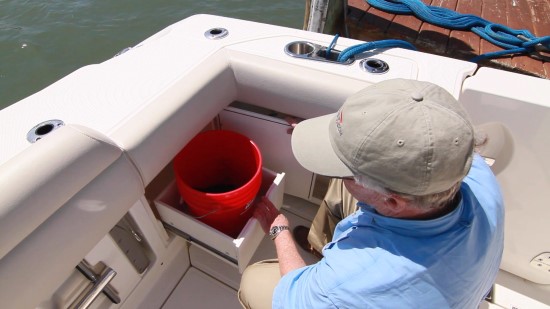
A drawer is built into the transom to hold every boater's best friend.
At the bow, we can create an elevated platform, complete with diamond non-skid that’s great for a cast netter or bait caster.
Lastly, a tuna door is to the port side bulwarks for hauling that big catch in, and when using it as a dive door, a reboarding ladder that stores close by at the transom mounts right in. A grab handle rotates into position from just inside the opening. Because this opens inward, this also makes an ideal spot to board from a floating dock. And Boston Whaler was clever enough to design the bulwarks to come out slightly to allow for walking right past the open door without the risk of jamming a leg into it… nice touch there.
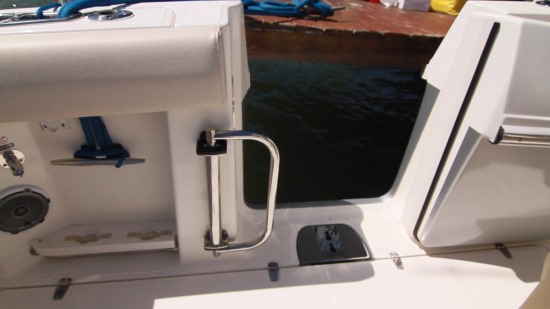
The hull side door provides a place to hole in the big catch, facilitates dive operations, and makes an ideal boarding area from a floating dock.
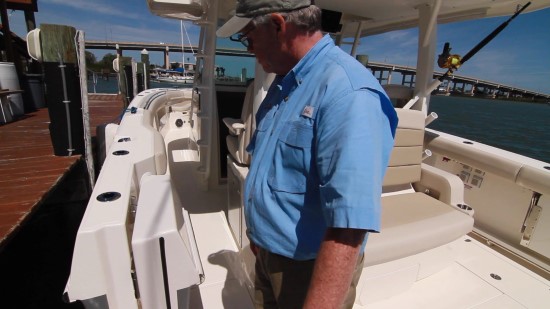
Notice how the bulwarks jog out slightly while the open side door is recessed in. This prevents anyone from jamming their legs into the open door.
Family Features
Families will also appreciate a lot of what the 380 Outrage has to offer and to us, the newly designed Outrage bow is the main attraction. The bulwarks are drawn outward to provide more room so facing each other does not equate to knees being interlocked. In fact, with 7’8” (2.34 m) between the bolsters, they’re not even close.
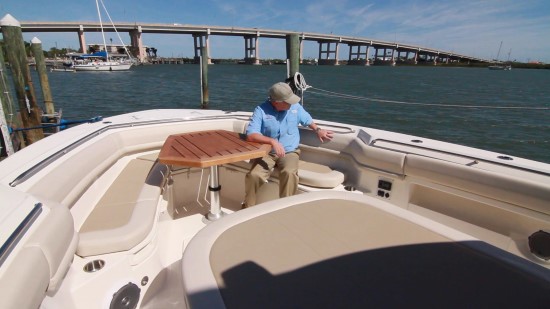
With the bulwarks drawn outward as the pollsters move forward, more room is created at the bow. This is a design feature we're seeing across the Outrage line.
Sitting forward, the seat bases flip up to form backrests and the arms are drawn to the top of the bolsters 20” (51 cm) above the seat cushions recessed grab rail. The teak table actuates up and down and a pad on top will convert the whole area into a sun pad.
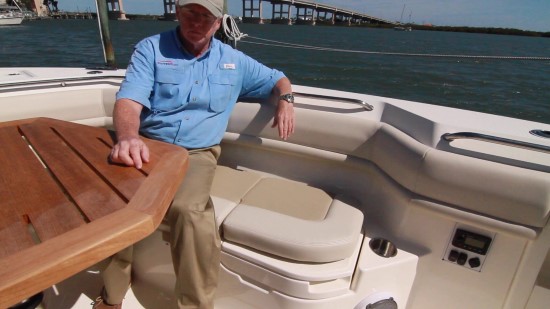
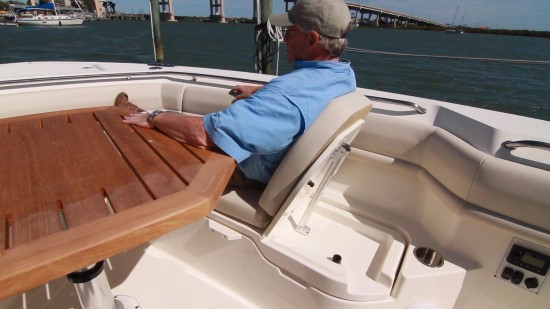
The forward V-seating easily converts to forward-facing seating by flipping up the seat base.
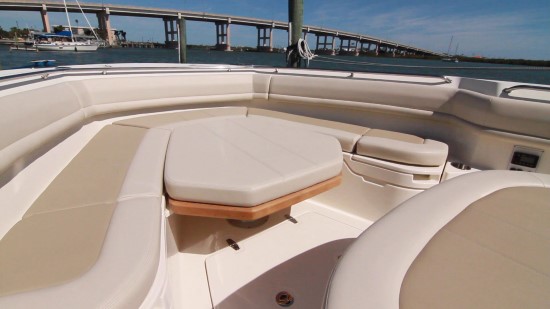
With the table lowered a forward sun pad is created. The table raises and lowers on an electric actuator.
Bow Lounge
Just behind is a large doublewide lounge. Armrests are to the sides and in the center, an armrest flips down that includes a pair of beverage holders, a self-draining cell phone cubby and a connectivity port just behind.
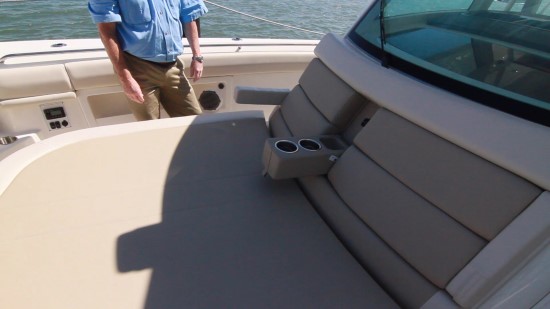
The bow lounge will probably be one of the most comfortable places onboard the 380 Outrage.
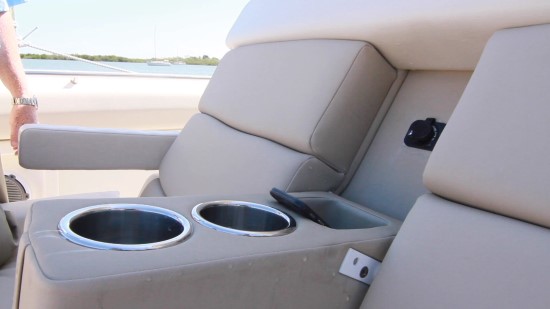
The center armrest includes two drink holders, a self-draining cell phone cubby, and a USB connectivity port.
Bow Storage
The storage in the bow is greatly improved over the previous models. In the deck between the V-seats alone we can fit several 5-gallon (18.93 L) buckets in this 3’2” x 3’ x 20” (.97 m x .91 m x 50.8 cm) compartment. If the electrically actuated table isn’t chosen then this can be a macerated fish box.
The V-seat storage opens with a single remote latch for one-handed access. And there have been great improvements to the storage under the lounge seating. With previous models, this was the location of the rod storage, so to get to anything, the rods had to come out first. Now, the rods are moved into the cabin, in a climate-controlled environment by the way, so this is now a wide-open storage space that can hold huge amounts of gear and tanks.
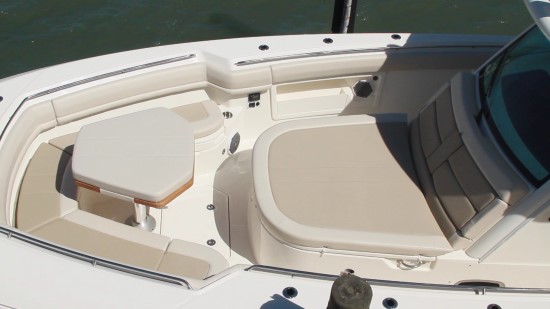
Taken all together, this is a luxurious gathering area feature packed with some of the most sought after amenities customer feedback could compile.
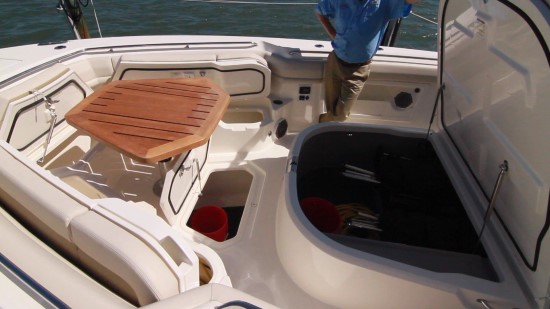
The bow alone has as much storage as we've seen on other boats in their entirety.
At the Side Decks
As we move back, to both sides the rail tops out at 36” (91 cm) with 20” (51cm) wide deck space. There’s open storage under the gunwales, a forward-facing speaker, cargo net storage and flip-down jump seats. The padded bolsters wrap-around the entire boat. To the port side of the helm seat, there’s a refrigerated drawer.
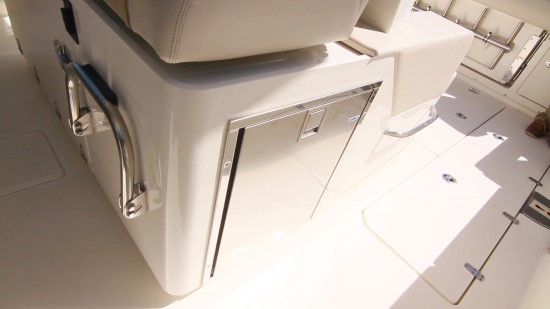
A refrigerated drawer is to the side of the helm seats.
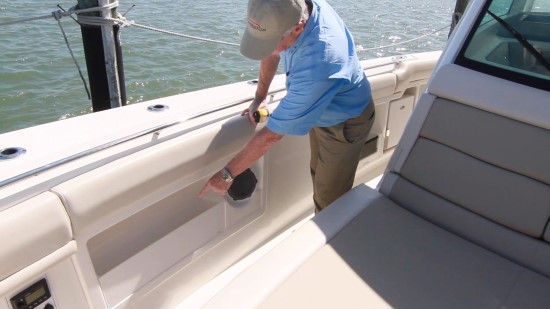
A multitude of features is to both side decks, including open storage with speakers just behind.
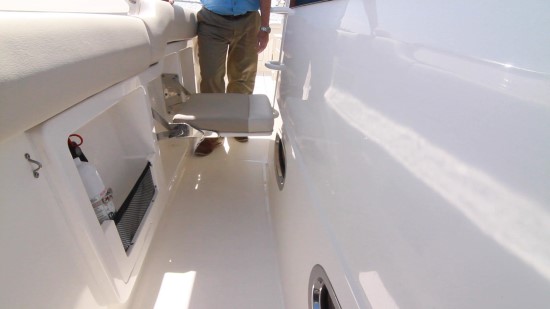
There are additional storage and a flip-out jump seat to both sides as well.
Back in the cockpit, the aft facing seat enhances the utility of the cockpit. It has storage underneath, converts quite easily to a buffet table, and notice the teak surface.
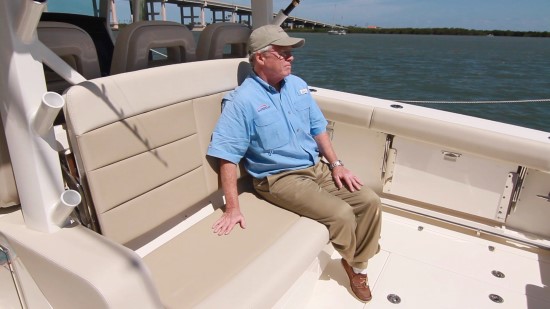
An aft-facing seat provides not only a welcome spot to watch the lines but a relaxing place to watch the wake shrinking in the distance.
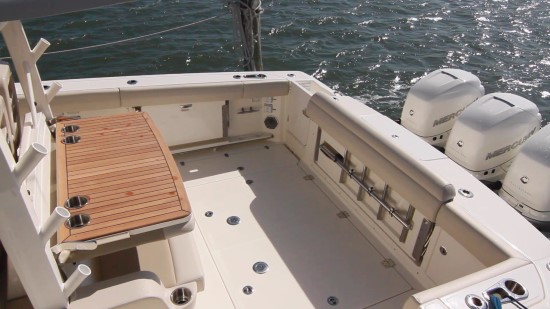
By pulling the seat back aft the seating converts into a buffet table with a teak surface and stainless steel beverage holders.
A flip-out seat at the transom adds even more seating and closes when more room is needed. We can also add a set of cockpit tables for even more versatility and there’s yet another flip down seat to the starboard bulkhead. The tables store close by under the deck hatch, and notice how cleverly the brackets allow the table to pivot away before sliding out. Overhead a retractable awning electrically actuates to provide shade to the entire cockpit area.
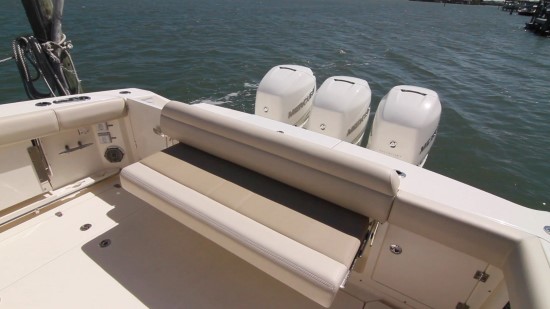
A flip-out transom seat is just one of the many seating options in this cockpit.
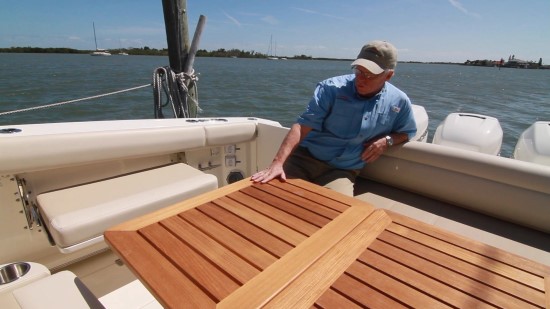
A pair of cockpit tables store underneath the mechanical room hatch. When installed, they can be surrounded on three sides by ample seating.
Cabin
With the starboard helm console, Boston Whaler created the ability to move the cabin entry to the area just to port of the helm. Now we can have a full weather enclosure option while still being able to access the cabin from that protected environment. This is a huge improvement over the side or front of the console entry. We measured 6’5” (1.96 m) to the overhead skylight.
With the working area of the helm moved to starboard, Boston Whaler created the ability to move the entry door to the cabin back under the protection of the overhead and optional side enclosure.
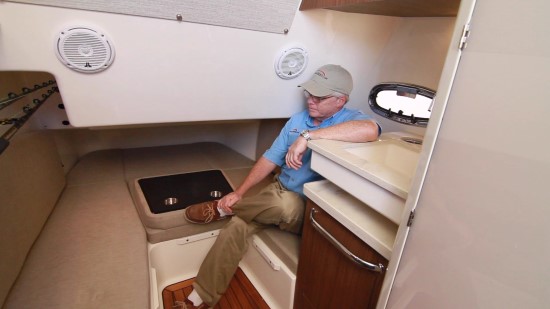
The cabin is large enough to house two overnighters in comfort.
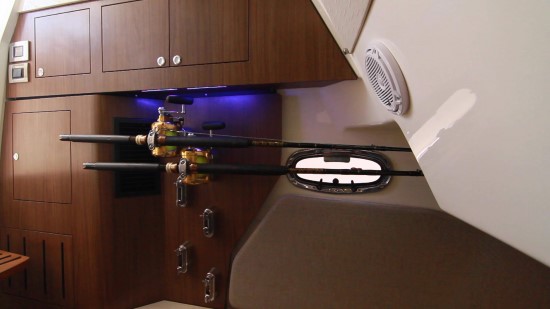
Rod storage has been moved down below in the cabin, freeing up space under the forward lounge.
To starboard, there’s a microwave behind a retractable door. Below there’s a vessel sink recessed into a Corian counter and an opening portlight is just beyond. Notice that the sink is elevated just above the counter so we also have a quick drop spot for cellphones and wallets, complete with a raised edge. Trash goes below. Ahead is a seating area that converts to a double berth.
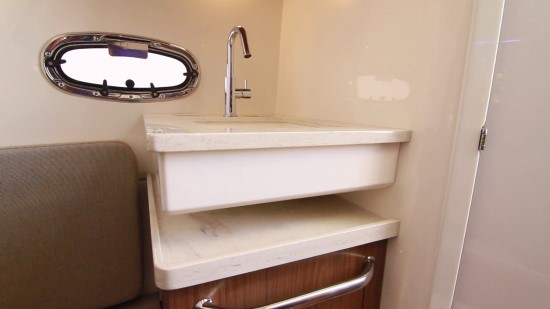
The sink is elevated just above the counter providing another convenient space to put items.
Storage solutions played a big part in the cabin. Of course, there’s the rod storage we discussed, that moves the rods out of the bow compartment. And there’s the blue courtesy lighting just above, adding a touch of bling to the high-end reels. Cabinets are above and shelving is above that.
Forward is where the real innovations take place. There’s regular V-seating, but by flipping the hinged cushions down, Boston Whaler added rubberized surfaces, so when we bring aboard our plastic storage totes, this gives us a place to put them without having then slide off. Additional bins, or other items, can go just ahead of the cushions and they’re also prevented from sliding by the cushions themselves. It’s a real-world solution and a clever one.
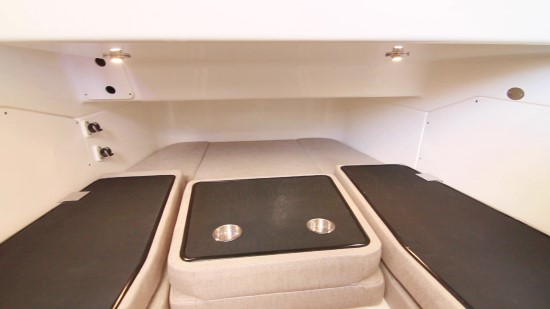
With the seatbacks flipped down, there’s non-skid storage on top and secure storage ahead for large bins we all bring aboard.
Head
However, the biggest improvement is the now fully enclosed head. The door is held open with a magnetic catch. The head includes a flip-down teak seat, pull-out shower wand, opening portlight, mirror, and our favorite feature… the flip down foul weather gear hooks… great place to dry out wet jackets. The heat and AC vent speed the process up.
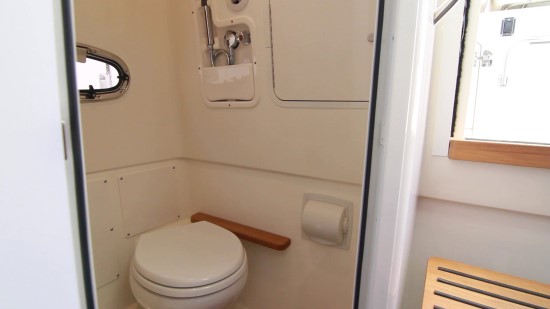
The head has been converted to a fully enclosed model on the 380 Outrage.
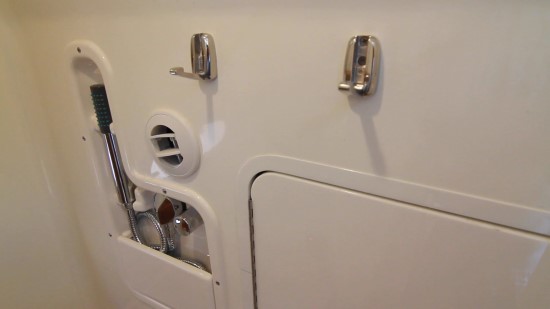
These flip down hooks in the head compartment make a great place for drying out foul weather gear.
Observations
Clearly, this is a boat with a lot to offer and she’s pretty well set up with everything customer research has shown that boaters in this class are looking for. Her new hull design performed flawlessly and the automatic controlling from the Mercury systems are a perfect complement. As for comfort, it’s everywhere we stepped, and then some.
Test Video Summary
Overview
The Boston Whaler 380 Outrage replaces the multi-award-winning 370 Outrage, with a new running surface, many improvements above and below deck, and styling that complements the rest of the Outrage line. BoatTEST’s Captain tested her with triple 350-hp Mercury Verados, and in an update with the new quad 400-hp Verado option.
“Clearly this is a boat with a lot to offer, and she’s pretty well set up with everything customer research has shown that boaters in this class are looking for.”
Mission And Intended Owner
- Built To Do: Offshore fishing and family cruising
- Designed For: Anglers and families who want everything boaters in this class look for
- Locus Of Operation: Offshore
Design Overview
- Hull: Newly designed from a clean sheet of paper
- Entry: Narrow, for clean penetration
- Deadrise: New 23-degree deadrise, for a soft re-entry with water thrown wide and low
- Console: Aggressive, angular, modern styling, offset to starboard, with the helm station on centerline
- Hardtop And Tower Supports: Integrated into the console so they don’t impede the side decks
- Cabin Entry: Moved to port of the helm, so the cabin is reachable from inside the full weather enclosure
- Colors: Cushions and dashboard changed from gray to tan
“This is a huge improvement over the side or front of the console entry.”
Specifications
- Length Overall: 38 feet
- Beam: 11 feet, 8 inches
- Draft: 23.5 inches
- Empty Weight: 14,500 pounds
- Fuel Capacity: 445 gallons
- Deadrise: 23 degrees
- Cockpit: 45 square feet
- Livewell: 60 gallons, divided
- Side Rails: 36 inches high
- Side Decks: 20 inches wide
- Bow Seat Spacing: 7 feet, 8 inches between facing seats
- Bow In-Deck Storage: 3 feet, 2 inches by 3 feet by 20 inches
- Helm Headroom: 6 feet, 8 inches under the enclosure storage
- Cabin Headroom: 6 feet, 5 inches to the skylight
Test Conditions And Test Weight
- Sea State: Protected water for performance testing, then offshore in 30-to-35-knot winds and 8-to-10-foot rollers
- Load: 44% fuel, two people and nearly 1 ton of optional features, including the tower and Seakeeper gyro
- Test Weight: 20,094 pounds
- Systems: Mercury Cruise Assist controlling engine speed and all engines on auto trim
Performance
Triple 350-hp Mercury Verados (16 x 17 Enertia Eco props):
- Top Speed: 50 mph at 6,200 rpm
- Best Cruise: 29.3 mph at 4,000 rpm, burning 32.7 gph
- Fuel Economy At Best Cruise: 0.9 mpg
- Range At Best Cruise: 359 miles, holding a 10% reserve
Quad 400-hp Mercury Verados (18-pitch props):
- Top Speed: 57.8 mph
- Best Cruise: 32.9 mph at 4,000 rpm, burning 42.4 gph
- Fuel Economy At Best Cruise: 0.8 mpg
- Range At Best Cruise: 312 statute miles, holding a 10% reserve
Power Options: New quad-engine setups in 350 or 400 hp
| Power |
RPM |
MPH |
GPH |
MPG |
Range |
| Triple 350s (cruise) |
4,000 |
29.3 |
32.7 |
0.9 |
359 miles |
| Triple 350s (top) |
6,200 |
50 |
— |
— |
— |
| Quad 400s (cruise) |
4,000 |
32.9 |
42.4 |
0.8 |
312 SM |
| Quad 400s (top) |
— |
57.8 |
— |
— |
— |
Acceleration (Quad 400s):
- Time To Plane: An average 3.8 seconds
- 0–20 mph: 5.4 seconds
- 0–30 mph: 7.5 seconds
“For our first time testing with everything on full auto... both systems performed flawlessly.”
Sea Trial And Handling
- Protected Water: Responsive and well-mannered
- Offshore (30–35 Knots, 8–10-Foot Rollers): Solid, predictable and well-mannered, handling with the grace of the 420
- Entry: Clean penetration
- Re-Entry: Soft, with water thrown wide and low
- Spray: Still some in high winds, but minimized by the new design
- Trim Tabs: The automatic dynamic tab system lowers the nose in heavy seas
- Seakeeper: Worked great, appreciated by families and by anglers standing for long periods
“Turns out, this 380 Outrage handles with the grace of the 420. Solid, predictable, and well-mannered. It was unbelievable. There was never a moment where we felt compromised.”
“The ability of the dynamic tab system to lower the nose in this heavy surface is just without equal, and it’s all automatic.”
Engine Room Or Mechanical Compartment
- Access: Deck hatch in the cockpit, with a flip-down deck to make working easier
- Batteries: Underneath the flip-down deck
- Contents: All mechanical components in one compartment, including:
- Fire suppression system
- Two fish box macerator pumps
- Holding tank discharge
- Livewell pump
- Three power steering pumps
- Battery charger
- Fresh and raw-water pumps and water manifolds
- Automatic battery switches and parallels
- Fuel filters
- Air conditioning pump and gyro pump
- Raw-water strainers
- Bilge pumps
- Generator
- Engine Flush: Auto flush system flushes all engines with one hose and a switch
- Electrical Panels: 110-volt panel at the cabin entry; 12-volt panel and ignitions on the starboard bulkhead by the helm seats
- Seakeeper: Behind a panel at the helm
- Overhead Height: 6 feet, 8 inches at the helm, 6 feet, 5 inches in the cabin
“Basically, all the mechanical components of the 380 are combined into this one compartment.”
Features Inspection
The Helm
- Glass: Tempered on three sides, with an electrically actuated vent at the top of the forward windshield and defrost vents behind
- Panels Facing The Operator: Seakeeper, Active Trim and the latest VesselView
- Glove Box: Opening, with tension hinges
- Centerline: Operator, helm and compass
- Dash: Soft-touch vinyl dash, cover and brow, with a storage spot including an accessory plug and USB port
- Switches: Rocker switches across the top, including a heat and AC boost switch and forward vent switch
- Climate: Heat and AC vents in the center
- Displays: Two 16.5-inch GS screens on an acrylic backing
- Controls: Three engine start-stops, Fusion stereo, spotlight remote, stainless wheel with a steering knob on a tilt base, automatic trim tabs, digital throttle and shift
- Joystick: Mercury JPO with heading hold autopilot, waypoint steering, Skyhook, Drift Hook and Bow Hook
- Footrests: Dual
- Enclosure Storage: Directly overhead
- Seats: Three across, each with individual armrests and bolsters, with the captain’s seat electrically adjustable fore and aft
- Observer Footrest: Separate flip-down footrest for the port observer
- Elevated Deck: Flip-down, raising shorter captains 6 inches, with anti-fatigue decking
“The port side observer gets a separate flip down footrest, since this seat is not at the console, and I love this.”
Upper Control Station
- Access: Stairs and a sliding hatch to port
- Equipment: Small nav display, VesselView display, remote spotlight control, horn, start-stops, tilt steering, VHF, engine controls and joystick
- Seat: Double wide with individual bolsters and storage underneath
- Outriggers: To the sides
- Shade: Protective hardtop overhead
Anchor Locker And Ground Tackle
- Windlass: Vertically mounted Lewmar, under a hatch
- Anchor: Through the stem
- Cleat: For securing the rode
- Remote: Mounted in the void area, with a washdown spigot and room to reach the rode
- Hatch: Finished on both sides, with a stainless support strut and a turn-and-lock latch
- Foredeck: Diamond non-skid, with pull-up cleats and rod holders
Boarding Amenities
- Dive Door: Port side, opening inward, ideal for boarding from a floating dock
- Reboarding Ladder: Stores at the transom and mounts into the dive door
- Grab Handle: Just inside the door
- Bulwark Shape: Angled out slightly so you can walk past the door without hitting your leg
“Notice how the bulwarks come out slightly to allow you to walk right past the door and not jam your leg into it. Nice touch there.”
Cockpit Arrangement And Equipment
- Fighting Room: 45 square feet
- Fish Boxes: Huge, refrigerated and macerated, on both sides
- Lighting: Spreader lights, two-color courtesy lights
- Camera: Remote camera
- Rod Holders: In the hardtop supports
- Quarters: 10-inch cleats, washdown spigots, speakers and cannonball holders built into tow rails
- 5-Gallon Bucket Drawer: Alongside
- Deck Drainage: Cambered to channel water to twin drains on each side
- Livewell: 60 gallons at the transom, divided to separate baits and reduce sloshing
- Aft-Facing Seat: With storage below and a teak surface, converting to a buffet table
- Transom Seat: Flip-out
- Cockpit Tables (Optional): Stored under the deck hatch on clever pivoting brackets
- Starboard Bulkhead Seat: Flip-down
- Awning: Electrically retractable, shading the entire cockpit
- Refrigerated Drawer: To port of the helm seat
Side Decks
- Rails: 36 inches high
- Width: 20 inches
- Features: Storage, forward-facing speakers, cargo net storage and flip-down jump seats
- Bolsters: Padded, wrapping the entire boat
Bow Arrangement
- Layout: Newly designed, with bulwarks drawn outward for knee room
- Facing Seats: 7 feet, 8 inches apart
- Backrests: Seat bases flip up, with arms 20 inches above the cushions
- Grab Rail: Recessed
- Table: Teak, actuates up and down, with a pad that converts the area into a sun pad
- Console Lounge: Large, double wide, with armrests and a center flip-down armrest with beverage holders, a self-draining phone cubby and connectivity
- In-Deck Storage: Holds several 5-gallon buckets, or a macerated fish box without the electric table
- V-Seat Storage: Single remote latch for one-handed access
- Lounge Storage: Wide open, now that rods have moved to climate-controlled storage below
- Casting Platform: Everything lowers to form an elevated diamond non-skid platform
“Taken all together, this is a luxurious gathering area feature packed with some of the most sought after amenities customer feedback could compile.”
Interior Spaces
Cabin:
- Headroom: 6 feet, 5 inches to the overhead skylight
- Microwave: Behind a retractable door to starboard
- Sink: Vessel sink on a Corian counter, raised to create a phone and wallet drop spot with a raised edge
- Port Light: Opening
- Trash: Below
- Berth: Seating that converts to a double berth
- Rod Storage: Climate-controlled
- Lighting: Blue courtesy lighting
- Storage: Cabinets and shelving above; seatbacks flip down to rubberized surfaces that hold storage totes in place
“This is a real world solution and a clever one.”
Head:
- Type: Fully enclosed, the biggest below-deck improvement
- Door: Held open with a magnetic catch
- Fixtures: Flip-down teak seat, pullout shower wand, opening port light and mirror
- Foul-Weather Hooks: Flip-down, The Captain’s favorite feature, with heat and AC vents to speed drying
Advantages And Disadvantages
Advantages
- New 23-degree hull that was solid and predictable in 8-to-10-foot rollers
- Soft re-entry with spray minimized
- Automatic trim tabs and auto trim worked flawlessly
- Top speed of 57.8 mph with quad 400s
- All mechanical systems in one easy-to-work compartment
- Auto flush for all engines with a single hose
- Refrigerated, macerated fish boxes and a 60-gallon divided livewell
- Inward-opening dive door ideal for floating docks
- Cabin entry reachable from inside the weather enclosure
- Fully enclosed head with foul-weather gear hooks
- Spacious redesigned bow with facing seats 7'8" apart
Disadvantages
- Some spray still comes aboard in high winds
- Fuel economy under 1 mpg at best cruise with both power packages
- Quad 400s reduce best-cruise range to 312 miles, from 359 with triple 350s
- Tower, Seakeeper, electric table and cockpit tables are options that add weight and cost