Which Prop is Better For Your Boat: 4 Blades or 3 Blades?
For many years now, boaters have debated the question of 4-blade propellers versus those with 3 blades. The traditional argument is that 4-blade props are slow and 3-blades are fast, end of discussion. Today, new trends in the marine marketplace, constantly fluctuating fuel prices, and shifting economic times are causing boaters to take a second look at this old debate. Speed is now a much smaller part of the boating equation and now practical, real-world performance is the name of the game for most people. Which props should you be using, 4-blade or 3?
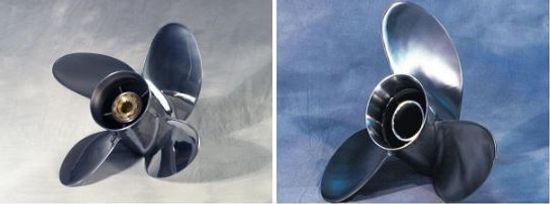
In the beginning, the idea that 4-bladed props were slower than those with 3 blades was true to a certain extent, but that is because many of those 4-blades were not designed with speed in mind. Instead, the few designs that were available were intended to cure handling issues such as ventilation, cornering blowout, motor elevation requirements, and hole-shot issues. Without many options in blade design, and very few of them truly intended to be particularly fast, the 4-blade got branded as slow, while their other performance benefits were largely dismissed.
By contrast, today’s 4-blade propeller designs have evolved into both all-purpose and highly specialized geometries. These propellers can be tailored not only to address those traditional handling issues but can also be tailored to improve a boat’s performance envelope, which can, in some cases, even include speed.
Reasons for 4 Blades
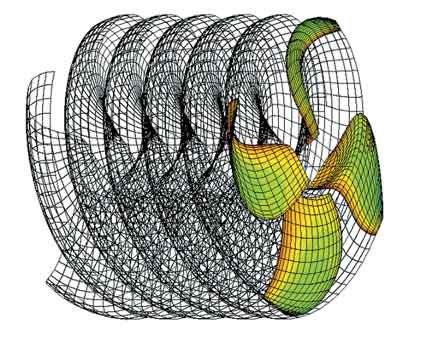
The increased blade area afforded by the addition of the fourth blade can provide increased water displacement capability, lift, and grip, as compared to a 3-blade propeller.
In terms of actual boat performance, these characteristics can combine to enhance:
- Handling
- Hole Shot
- Low-speed planing ability
- Cruise efficiency
- Fuel efficiency
- Load-carrying capability
- Performance in big or following seas
- Ventilation/cavitation resistance
- Motor-elevation capability
In short, a 4-blade propeller can improve all those characteristics that make for practical, all-around boat performance.
But are 4-Blades Slow?
So, why might a 4-blade generally be slower than its 3-blade counterpart? To be honest, many 3-blade/4-blade speed comparisons are simply not fair. That’s because the respective propellers in question are simply different styles, designed with different purposes in mind—different diameters, rakes, cupping, and blade shapes.
If however, for comparison purposes, we take two propellers, identical in design (blade shape, diameter, rake, cup, etc.) that are appropriate for a given application, and simply add a propeller blade, we get a truer representation of just where the difference lies.
The addition of the extra blade causes increased drag, which, in turn, requires more horsepower, in order to achieve the same rpm. Since the horsepower is limited, the rpms drop, and the speed will tend to drop with it. This is why, when going from a 3-blade to a 4-blade, the pitch is dropped an inch, or more, in order to keep rpm parity. It is this difference in pitch that causes any potential speed differentials between the 3-blade and the 4.

As to any actual speed loss between the two, in many cases, it is actually quite small (generally 1-3 mph). The reason is, although the 4-blade is one-inch lower in pitch, it runs more efficiently than its 3-blade competitor, allowing it to run closer to its theoretical speed than the 3-blade, thereby, effectively closing the gap presented by the pitch differential.
Designing the Solution
As we have learned more about what makes a propeller work and not work, and about how boats and motors perform and do not perform, we have designed propellers that address the inherent strengths AND weaknesses of each of these respective pieces of the puzzle. These designs have become even more important as more and more specialized boat designs and motor trends have entered the marketplace and as new trends and economic challenges arise.
All that said, the most important part of the equation remains the customer’s performance expectation and satisfaction. So, the goal is to match the propeller to the boat, motor, AND the customer’s needs… as always, the right tool for the right job.