A Throwable Device: You’ll Only Need it Once!
Recently we did an article on the Mustang Rescue Stick, pictured above. In the intro to the article we said that throwable devices were required on every boat and one of our perceptive readers -- as you usually are -- picked up on our mistake. They are actually only required on boats 16’ in length or longer, so thanks for the catch! Our second mistake, was to only use the article to promote the device.
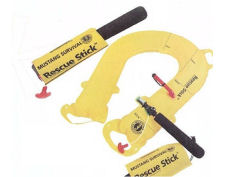 The Mustang Rescue stick is an example of a throwable device that inflates when immersed in water. |
Surprisingly, not many people know how to use their throwable PFD and even fewer have practiced using them. Check out his advice and see if you are ready if and when trouble strikes.
First the Rules...
Often you will see a disparity between the State and Federal level with regards to equipment requirements for small boats. In this case, however, they both are in agreement and a throwable device, also known as a Type IV PFD, is required only if your boat is 16’ in length or longer.
Under 16’, you aren’t required to have a Type IV onboard, but that’s like saying you aren’t required to wear a seat belt in your car. Are you really not going to do it because it’s not a law? That’s the kind of mindset that has legislators creating laws to protect us from ourselves. Better is to do the right thing and save the rest of us from having a law passed telling us to do it. In the case of the 16’ rule, I’m sure you can agree that it’s best to have a Type IV throwable device even if you’re in a canoe.
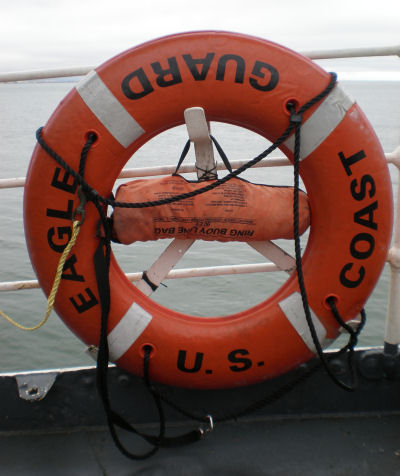 The ring type of Type IV throwable device. Ready to go in a moment’s notice. |
So Where Is It Kept...
Certainly not in storage, that’s for sure. That seems to be a common sense fact that escapes some boaters. I’ve seen them wrapped in the original plastic from the store, stowed under the seats, in lockers... all sorts of places where they aren’t in reach in a moment’s notice.
Most often, people have the cushion type that you sit on, but… in a couple of states, they’ve even gone and made it illegal to sit on them! Why one or two legislators are able to pass a law that makes you put this pivotal device someplace else besides under your butt is beyond me. But I digress...
Other types of type IV’s are the horseshoe shaped ones, or ring types, both of which hang in a bracket on the rail or bulkhead.
 When you’re treading water, having something thrown to you to hang onto can be a lifesaver... so to speak. |
So How Do You Use It...
Well there are two schools of thought and both are correct: first, we’ll discuss my preferred method and it’s the one I teach. To begin, let’s agree on the point that the throwable device is a “man overboard” tool (and I use “man” throughout this article as a generic term so kindly save your cards and letters). When you have someone go over the rail, the throwable device goes over right after -- as soon as possible after! Here’s the run down, and by all means, you should practice this with your family once in a while to be sure everyone knows the procedure.
1. A person goes over the rail. Hopefully this event will be noticed by someone onboard. If you ever go over the rail, you desperately need to be noticed, so yell as you go over. This is the closest to the boat that you are going to be, so this is the best time to draw attention to the fact that you are departing the boat. Don’t be embarrassed by you clumsiness, because things are about to get far worse.
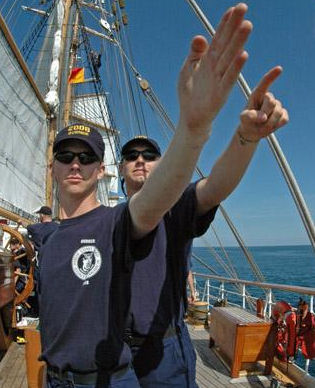 Point at the man overboard until the helmsman has the person firmly in sight. |
2. Next someone immediately throws a throwable device over the rail, getting it as close to the person in the water as possible. At the same time, yelling “MAN OVERBOARD”, and then pointing to the person in the water.
Now as to who throws the throwable over depends on several factors, mostly with the size of the boat. It may be the driver (sitting on the type IV if in a small runabout) or someone else (if a larger cruiser). Ideally, the person who saw the event is the one grabbing the nearest throwable device. If it’s not a cushion, it can be a life preserver, or for that matter anything that floats (cooler, seat cushion...). Your objective is two-fold. Give the person something to swim to, and mark the spot where the person went in the water.
3. Whoever saw the person go in and threw the throwable is now pointing at the person in the water. Do not take your eyes off that person in the water! A small dark head bobbing in the water is easy to lose track of if you look away. By pointing, you give the helmsman a target direction to turn to and also avoid clipping the person with the outdrive. Do not stop pointing until the helmsman says “I’ve got him”.
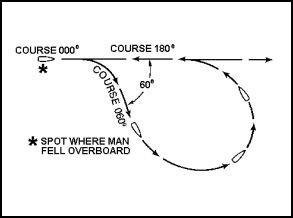 The Williamson Turn in this example is 60-degrees to starboard, then hard over to port until the reciprocal compass course is reached. |
4. The boat gets turned around. There are two methods of doing this. If the person is in sight, just turn around, ideally turning towards the person so that the stern gets pushed away from him. If the person is not in sight, like in the case of thick fog or heavy seas, then a Williamson Turn is in order.
Take a glance at your compass and note the reciprocal heading to the one you are on. Turn your helm to one side about 60 degrees. Then turn hard over the other way until you reach that reciprocal heading. The result will be a “P” sort of path that will have you traveling on the opposite heading AND on the same path you were on. Now the person in the water will be at, or just beyond your throwable device.
5. Make your pickup. Approach slowly, being careful not to run over the person in the water. (It happens, and sometimes with deadly results.)
The second method, I talked about, always has the Type IV secured to a long line. This is to aid in your pulling the person over to the boat. It’s a good practice, but one I’d save until the pickup time. If you throw that secured device in right away, you could very well end up towing it along with you, away from the person in the water, and now nothing is helping him, and nothing is helping you get back to that spot should you lose sight.
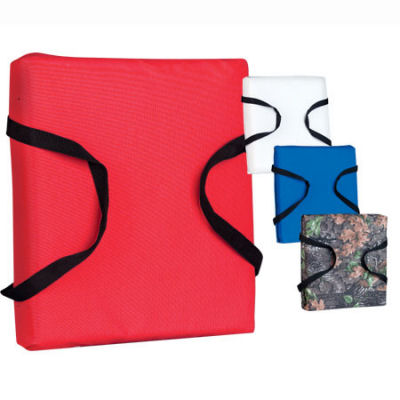 The cushion type is the kind most seen on recreational boats. |
Summary
Now all this happens in less time than it took to read about it, and it’s a scenario that should be practiced with your family. At a random time, throw a life preserver in the water and yell man overboard and watch what happens. Everyone should know what to do and how to do it. In this manner, when the real thing happens, there’ll be no fumbling around and the non-swimmer in the water will be retrieved, alive and well, to enjoy the rest of the day. And you’ll all go home with little more than a story to tell and a grateful passenger.