Pitch of the Prop Governs Performance
A lot of things affect a propeller’s performance, but perhaps the most important is the pitch of the prop. But there is more to it than that: There is both “constant pitch” and “progressive pitch” and then there is the “rake” and the “cup” built into the prop that will determine the ultimate effectiveness of the pitch. We asked the folks at PowerTech! -- our go-to source for prop information -- to shed some light on this important subject for us.
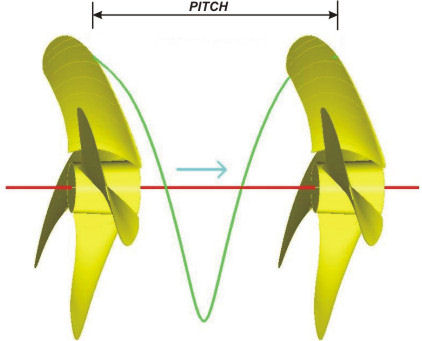 Pitch is the distance a propeller will move through a solid (as in a screw through wood) in one 360-degree rotation. For example, a 14” pitch prop will theoretically advance 14” for every complete rotation. Reality in water is something less than that. |
The pitch of a propeller must be carefully selected to make sure that it matches the power that is being applied to it. For example, if the pitch of a prop is too greate for the horsepower used to turn it, the engine will not be able to reach its rated max rpm and you will not be getting the speed out of the engine that you might have hoped for. Conversely, if the pitch is too slight, the prop will not be utilizing the full power of the engine available and again the boat’s optimum speed will not be reached. In addition to speed, improperly pitched props will also keep you for realizing optimum fuel consumption.
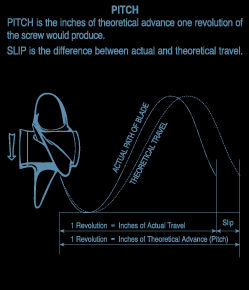 The difference between the theoretical distance the prop will travel in one 360-degree revolution and the distance the prop actually travels, is called slip, and it is expressed as a percentage of the theoretical distance. Slip varies depending on rpm and speed and is usually calculated at max rpm where it is usually least. |
Every change of, say, one inch of pitch will increase or decrease the maximum rpm your engine will be able to turn under load. Lower pitch to gain rpm, increase pitch to lose rpm.
 Note the propeller cupping in this drawing. |
Cup Size Matters
Cup assists in increasing the water gripping capability of the propeller, particularly on boats with elevated motor heights and high trim angles. Cup can also provide additional bow lift when utilized on the rake line of the prop. Applying cup to the trailing edge of the prop along the pitch line will increase the effective pitch of the propeller.
A standard cup will typically result in a decrease of 200 to 400 rpm's. This usually means a decrease in pitch of 1 to 2 inches is required to run a cupped propeller in place of an uncupped wheel.
 Note that the cup produced in the progressive design creates a foil shape somewhat similar to that on an airplane wing, which causes lift because of the high pressure and low pressure areas produced on each side of the prop as it turns. This is why a progressive pitch prop with cup actually increases the effective pitch of the prop. |
Constant Pitch vs. Progressive Pitch
Constant pitch propellers have a constant pitch across the entire propeller high pressure face. Progressive pitch propellers have a lower pitch at the leading edge which increases progressively across the blade face. This type of propeller typically provides superior planing performance because of the added lift.
“Blade Rake” represents the angle of attachment of the blade to the hub of the propeller. This is not to be confused with the pitch, which is a measure of the twist or screw progression. Higher rake normally improves performance in ventilating or cavitating situations (which are often caused by high engine elevations and high trim angles).
Additionally, higher rake can provide higher bow lift, which will frequently improve speed. Low rake blades are typically used on motors with propellers running fully submerged, typically carrying moderate to heavy loads. The rake angle can either be straight or the average angle of a parabolic curve.
If you have questions about getting better performance out of your props or re-propping your boat for optimal performance and fuel efficiency, then we suggest that your contact the folks at PowerTech!, -- propeller experts serving the recreational boating market since 1986.