Is Your Boat Infected with Mold Spores?
Over the last several years, mold remediation in houses has blossomed into a multi-million-dollar business and has kept many lawyers out of the soup kitchens. We’ve all lived with mold all of our lives, but it is now an environmental flavor of the month, so you’d better not be caught with your spores down. Not only does mold smell bad, it can be bad for your health and degrade the finish of your boat, costing you hundreds of dollars when you go to sell it.
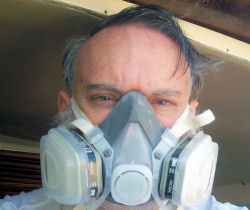
Capt. Pauley’s Report from thevirtualboatyard.com--
So what’s the big deal about mold? Well, mold spores can trigger asthma attacks or allergic reaction in persons exposed to them, especially the young and the old. Some mold spores produce toxins that are also dangerous. Long-term exposure to mold spores can cause health problems in healthy people. Mold has even been known to cause lung infections. In short, it’s not a pleasant thing to live with.
Mr. Clean
Mold remediation involves killing the active mold colonies, disinfecting and cleaning the affected surfaces and preventing reoccurrences of the mold infestation. This of course is after the source of moisture has been eliminated. On a boat, that usually means sealing the leaks and keeping the interior dry. Once that is done, the mold colonies are killed, the surfaces cleaned and then sealed or protected from future mold infestations.
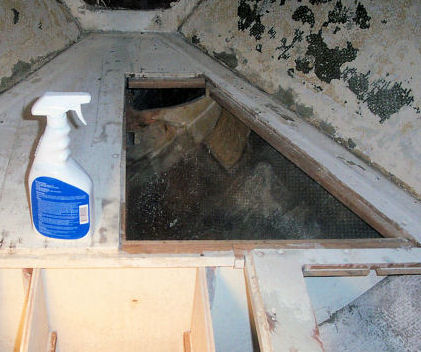
Be sure to wear appropriate personal protection while doing this remediation. This means gloves, eye protection and a respirator rated at N-95 or above.
The 6% Solution
#1. One solution often used for killing the mold is common household chlorine bleach, mixed with no more than one cup of bleach (8 oz.) to each gallon of water. Surfaces are wiped down or scrubbed with the bleach solution and then rinsed with water and dried.
#2. Another solution often used is hydrogen peroxide. This isn’t the common 3% solution found in most drug stores, rather it is anywhere from a 10% to 35% strength solution, depending on the source doing the recommending. Hydrogen peroxide of this strength is harder to find; try beauty-supply companies or swimming-pool-chemical suppliers.
#3.A third method is to use one of the numerous proprietary chemicals on the market for mold remediation. Many of these contain chemicals to kill the mold, additives to aid in stain removal and cleaning and other additives to prevent mold regrowth.
Mold Avenger
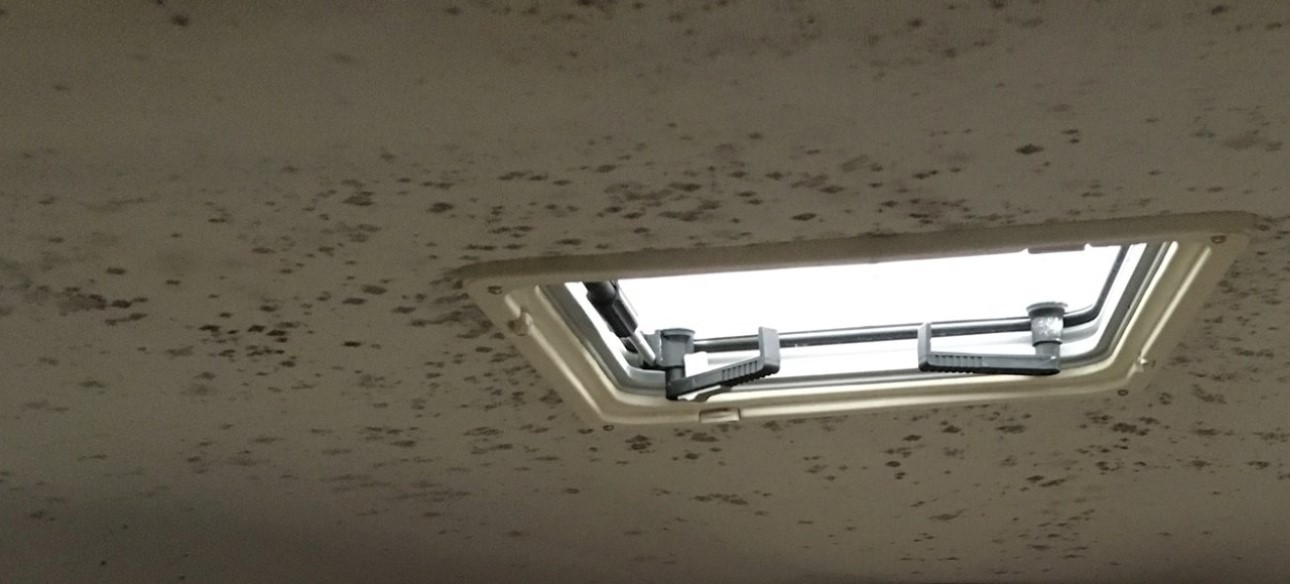
Mold Avenger comes as a dry powder in a spray bottle. Just prior to use, water is added to the bottle to dissolve the powder. After mixing, I sprayed the mixture on all the interior surfaces of Daydream affected by the mold. After letting it set for an hour or so, I started scrubbing the surfaces to clean up the mold residue and stains.
This is the point I really appreciated the benign character of the solution. Lying on my back in the v-berth scrubbing the overhead was no place to have a bleach solution or concentrated hydrogen peroxide running down my arms and dripping on my head. I did appreciate my goggles, hat and gloves, though.
The Mold Avenger did its job well (although I hate to sound like a commercial for the product.) It removed the stains and, after a fresh water rinse, left the surfaces ready for refinishing.
If You Don’t Believe Me…
If you don’t want to take my word for it, why not start your research where I started my search for mold remediation options -- on the Internet. Thanks largely to hurricanes Katrina and Rita, there is quite a bit of information about mold remediation available on the web. While much of it is focused on mold in homes, the information is also useful in remediating mold in boats. The EPA has the booklets "A Brief Guide to Mold, Moisture, and Your Home" and "Mold Remediation in Schools and Commercial Buildings" available for free downloading on their web site at: https://www.epa.gov/mold/
The Centers for Disease Control (CDC) also has a section of their web site devoted to mold, its effects and remediation. A section of Frequently Asked Questions (FAQs) can be found at: https://www.cdc.gov/mold/faqs.htm
Capt'n Pauley
Article courtesy of thevirtualboatyard.com